
 BEST SELLERS
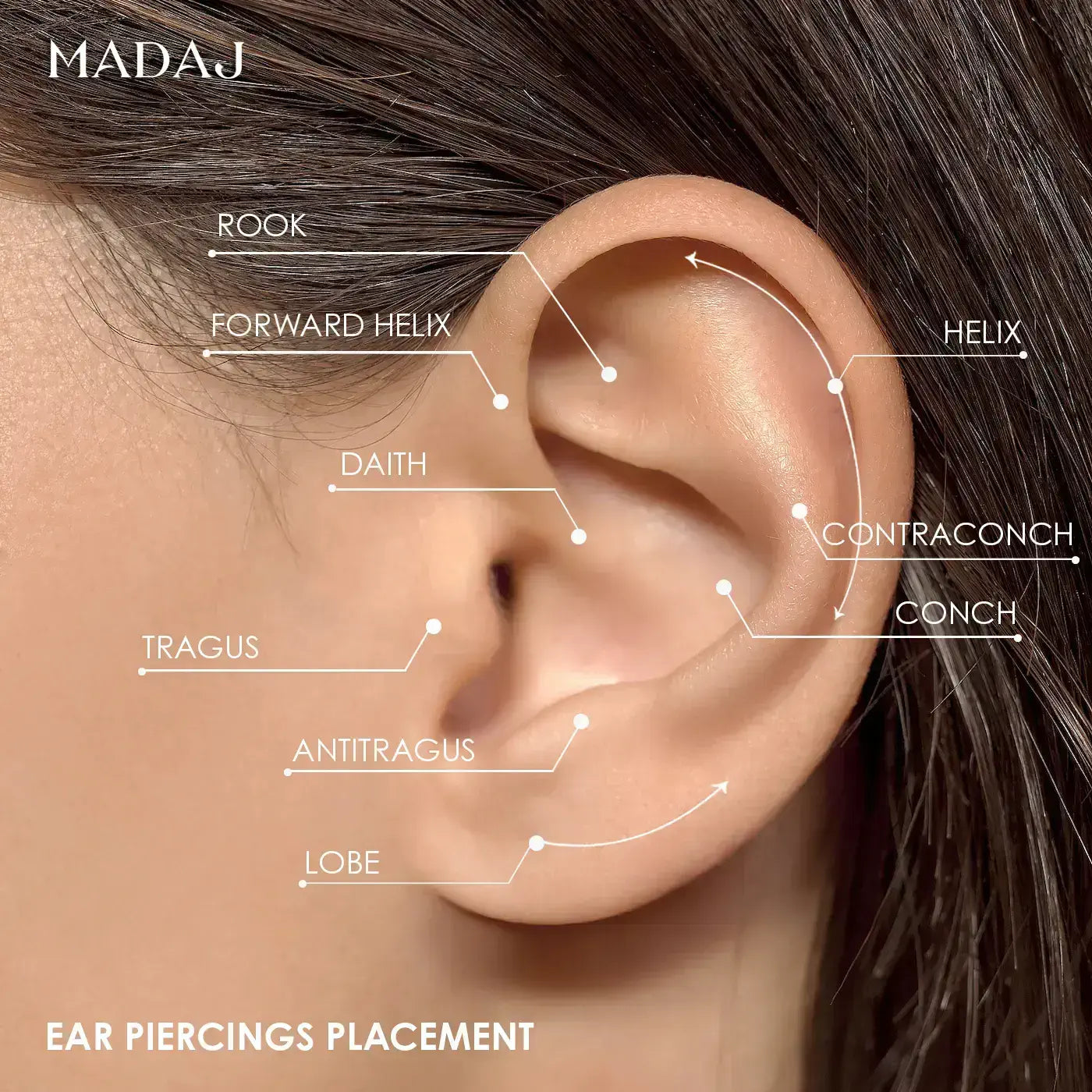
Ear Piercing Pain Chart: Every Piercing Ranked
If you are thinking about a new ear piercing, pain is probably the first thing that comes to mind. That is entirely normal. The honest answer is that yes, ear piercings do hurt, but the intensity varies enormously depending on where on the ear you get pierced, the thickness of the tissue, and your individual pain tolerance.
Lobe piercings barely register for most people. Cartilage piercings are a different story. The further you move into the dense, thick cartilage of the inner ear (the conch, the rook, the snug), the more you will feel it. But even the most painful ear piercings are over in seconds. What follows is soreness during healing, which is more about patience and good aftercare than raw pain.
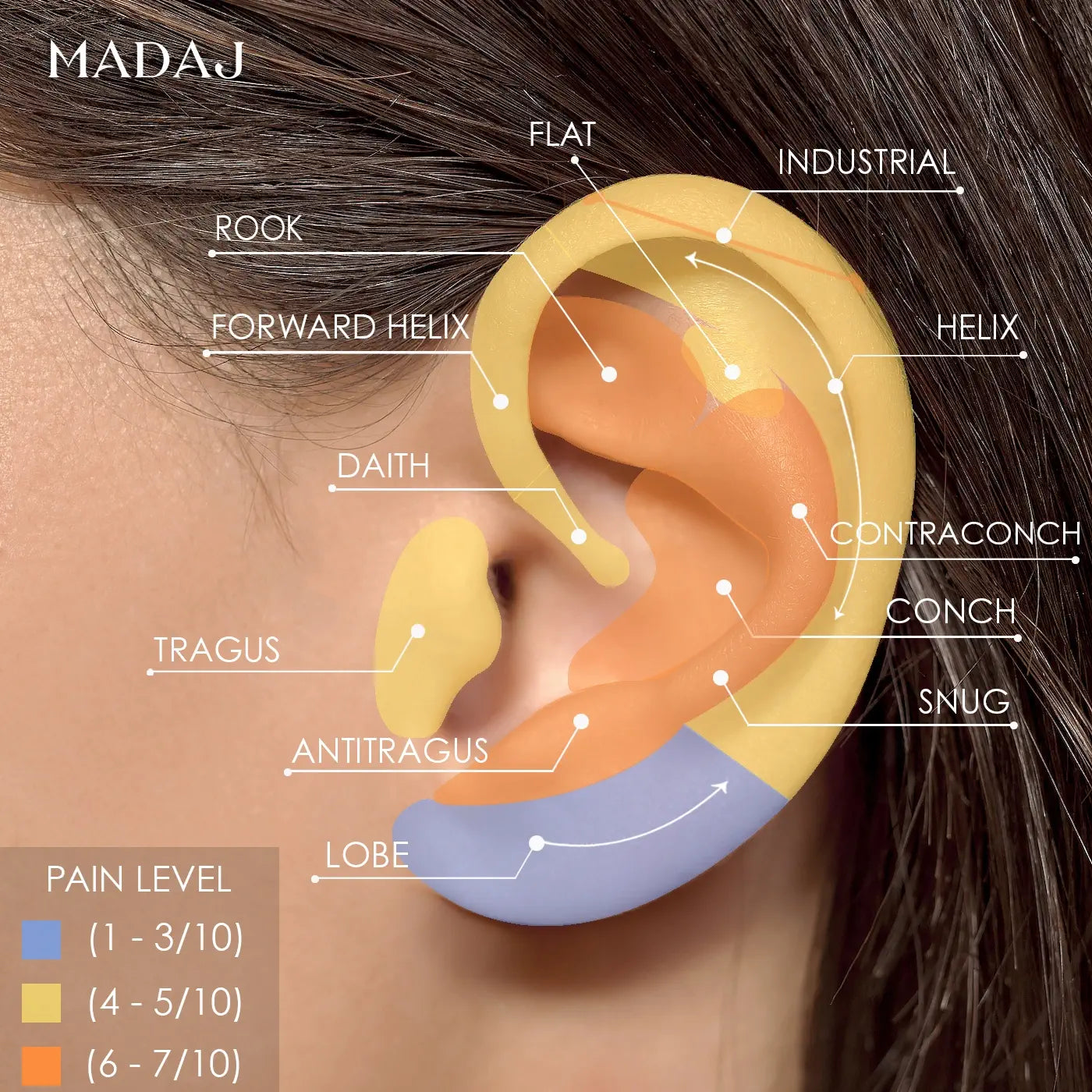
PAIN SCALE OF EAR PIERCINGS
At MADAJ, we have rated every ear piercing on a pain scale of 1 to 10, based on tissue type, cartilage thickness, and common experience. We have also included healing times for each, since recovery discomfort is part of the full picture. Use this guide to set your expectations, choose your next piercing, and prepare properly.
| Piercing | Pain | Healing | Why It Hurts |
|---|---|---|---|
| Lobe | 2/10 | 2–4 months | Soft tissue, minimal nerve endings |
| Helix | 4/10 | 6–12 months | Thin cartilage on outer rim |
| Tragus | 4/10 | 6–12 months | Small, thin cartilage flap |
| Forward Helix | 5/10 | 4–6 months | Firmer cartilage, less flexible |
| Flat | 5/10 | 6–12 months | Broad flat cartilage area |
| Daith | 5/10 | 6–12 months | Thick fold, deep location |
| Antitragus | 6/10 | 6–12 months | Dense cartilage, sensitive area |
| Rook | 6/10 | 6–12 months | Thick inner cartilage ridge |
| Orbital | 6/10 | 6–12 months | Two holes connected by one ring |
| Conch | 7/10 | 6–12 months | Thickest central cartilage |
| Contraconch | 7/10 | 6–12 months | Similar depth to conch |
| Snug | 7/10 | 6–12 months | Thick anti-helix cartilage |
| Industrial | 8/10 | 9–12 months | Two cartilage piercings at once |
WHAT AFFECTS HOW MUCH AN EAR PIERCING HURTS?
Pain is subjective, and two people getting the same piercing can have completely different experiences. That said, a few factors consistently
influence how much a piercing hurts.
Tissue type is the biggest factor.
Lobe piercings pass through soft, fleshy tissue with relatively few nerve endings and good blood supply. Cartilage piercings pass through dense, avascular tissue that the needle has to push through with more force. The thicker the cartilage, the more pressure required, and the more you feel it. This is why the conch, rook, and industrial piercings consistently rank higher on pain charts than the helix or tragus.
Individual pain tolerance varies widely.
Some people barely flinch during a conch piercing; others find a helix genuinely uncomfortable. Your persona pain threshold, how much sleep you got, whether you are well-hydrated, and even your stress level on the day all affect how you experience the moment.
Anxiety amplifies pain.
If you are tense and bracing for impact, your muscles tighten and your perception of pain increases. People who go into a piercingly calm, relaxed state almost always report less pain than those who are visibly anxious. Controlled breathing helps more than most people expect.
The piercer's technique matters.
An experienced piercer using sharp, high-quality needles will create a cleaner puncture with less tissue trauma than a less experienced piercer. Speed and precision make a real difference. This is also why needle piercings hurt less and heal better than gun piercings (more on that below).
Healing pain is different from piercing pain.
The needle going through lasts a few seconds. The soreness, tenderness, and sensitivity during healing can last weeks or months, depending on the location. Cartilage piercings tend to remain tender longer because cartilage has a limited blood supply, which slows the healing process.
EAR PIERCING PAIN LEVELS: DETAILED BREAKDOWN
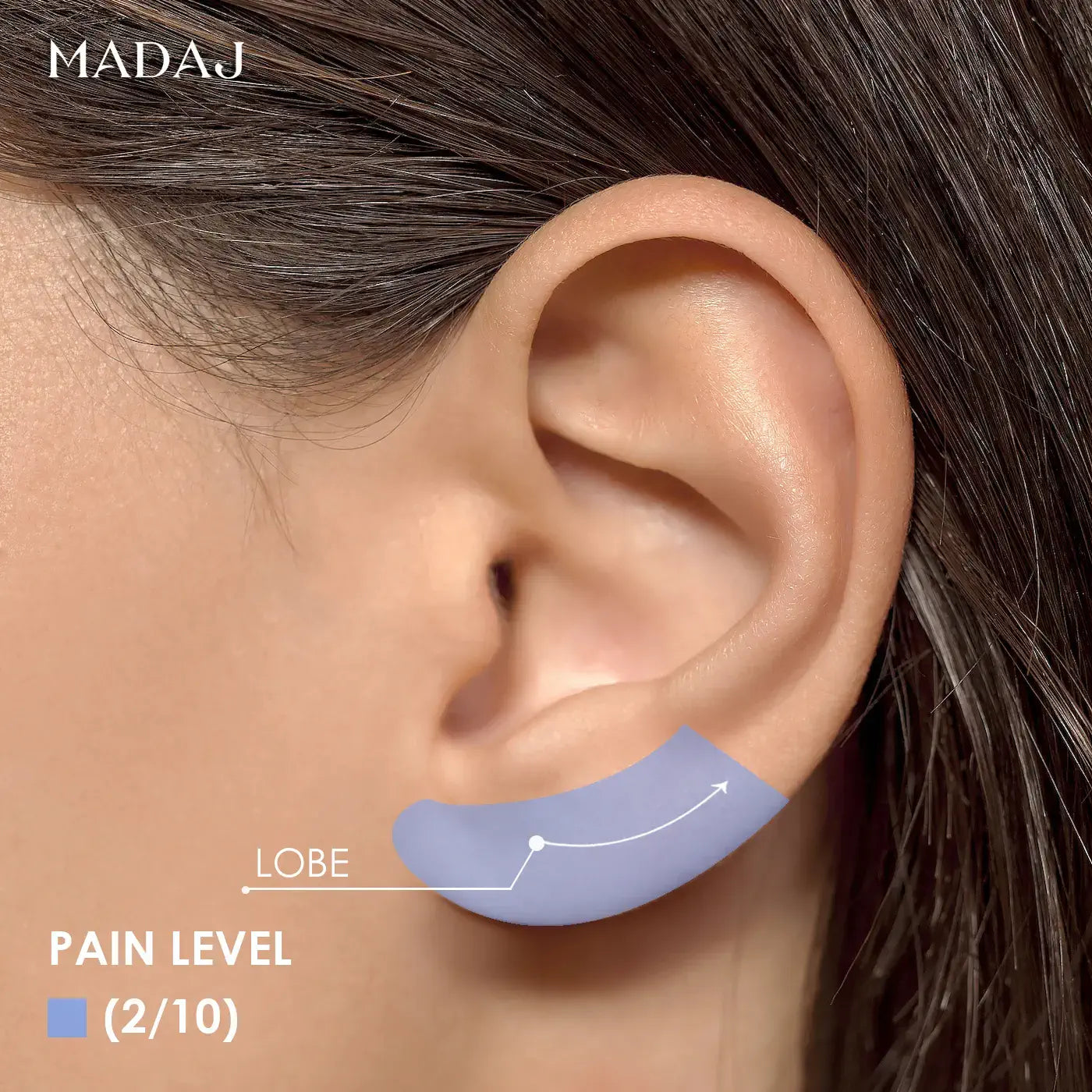
Lobe Piercing: 2/10
Healing time: 2 to 4 months
The lobe is the gentlest entry point into ear piercings. The tissue is soft and fleshy with minimal nerve endings, so most people describe the sensation as a brief, sharp pinch that fades almost instantly. If you have ever had a vaccination, you have a good frame of reference. Children routinely get lobe piercings with no lasting distress, which tells you everything you need to
know about the pain level.
Soreness for the first day or two is normal, but lobe piercings are generally comfortable within a week. They also heal faster than any other ear piercing because lobe tissue has excellent blood circulation.

Helix Piercing: 4/10
Healing time: 6 to 12 months
The helix runs along the outer upper rim of the ear, where the cartilage is relatively thin. You will feel a definite pinch and some pressure as the needle passes through, noticeably more than a lobe piercing, but it is over quickly.
Most people handle helix piercings without any issue, even as their first cartilage piercing. The longer healing time compared to the lobe is the bigger adjustment: six months to a year of being careful with headphones, sleeping position, and hair getting caught.
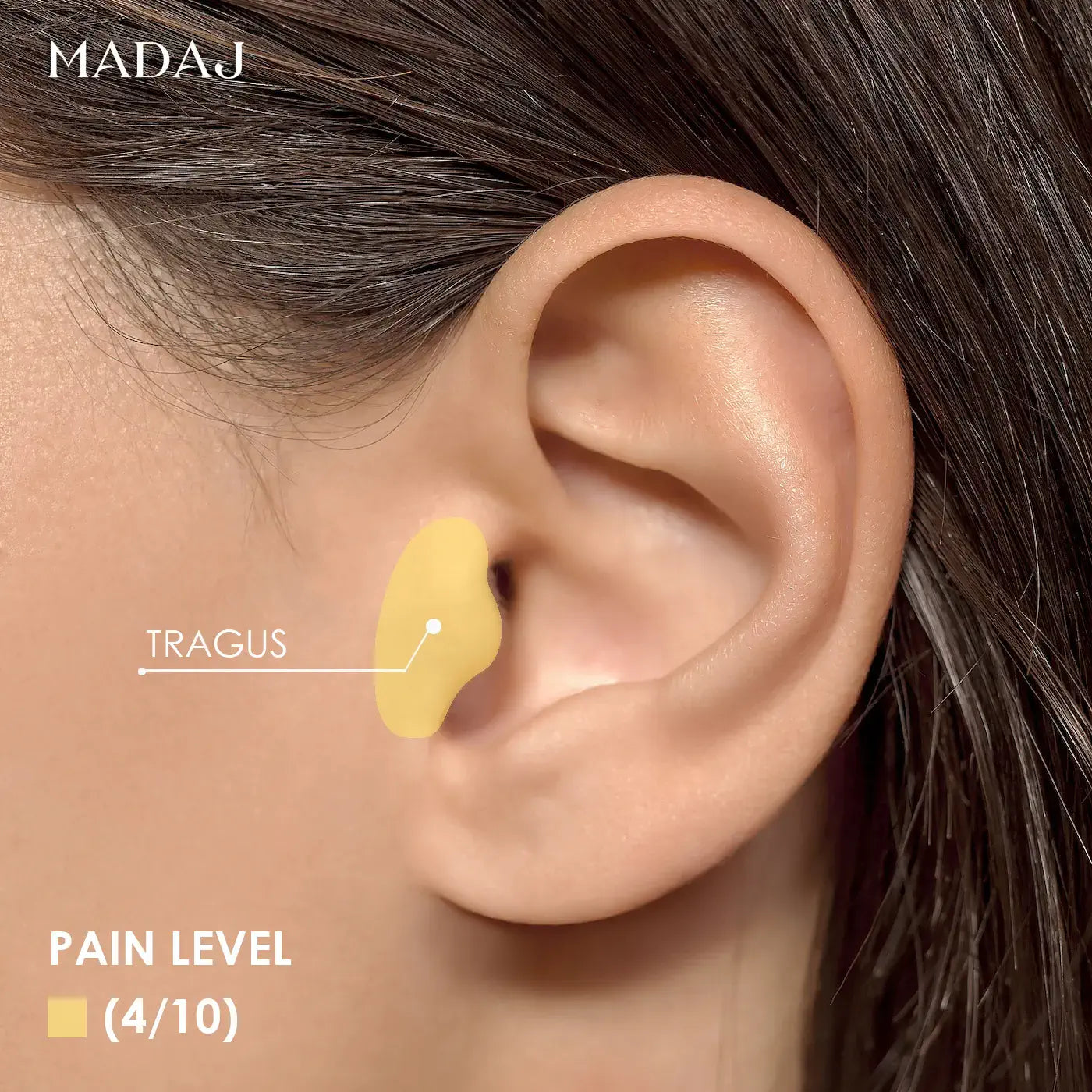
Tragus Piercing: 4/10
Healing time: 6 to 12 months
The tragus is the small triangular flap of cartilage covering the ear canal. Despite its intimidating location looking intimidating, the cartilage here is thin, and the piercing itself is quick. Many people report a popping or crunching sound (which is just the needle passing through cartilage) that is more startling than the pain itself. The pain is comparable to a helix piercing. The main inconvenience during healing is avoiding earbuds and in-ear headphones for several months.
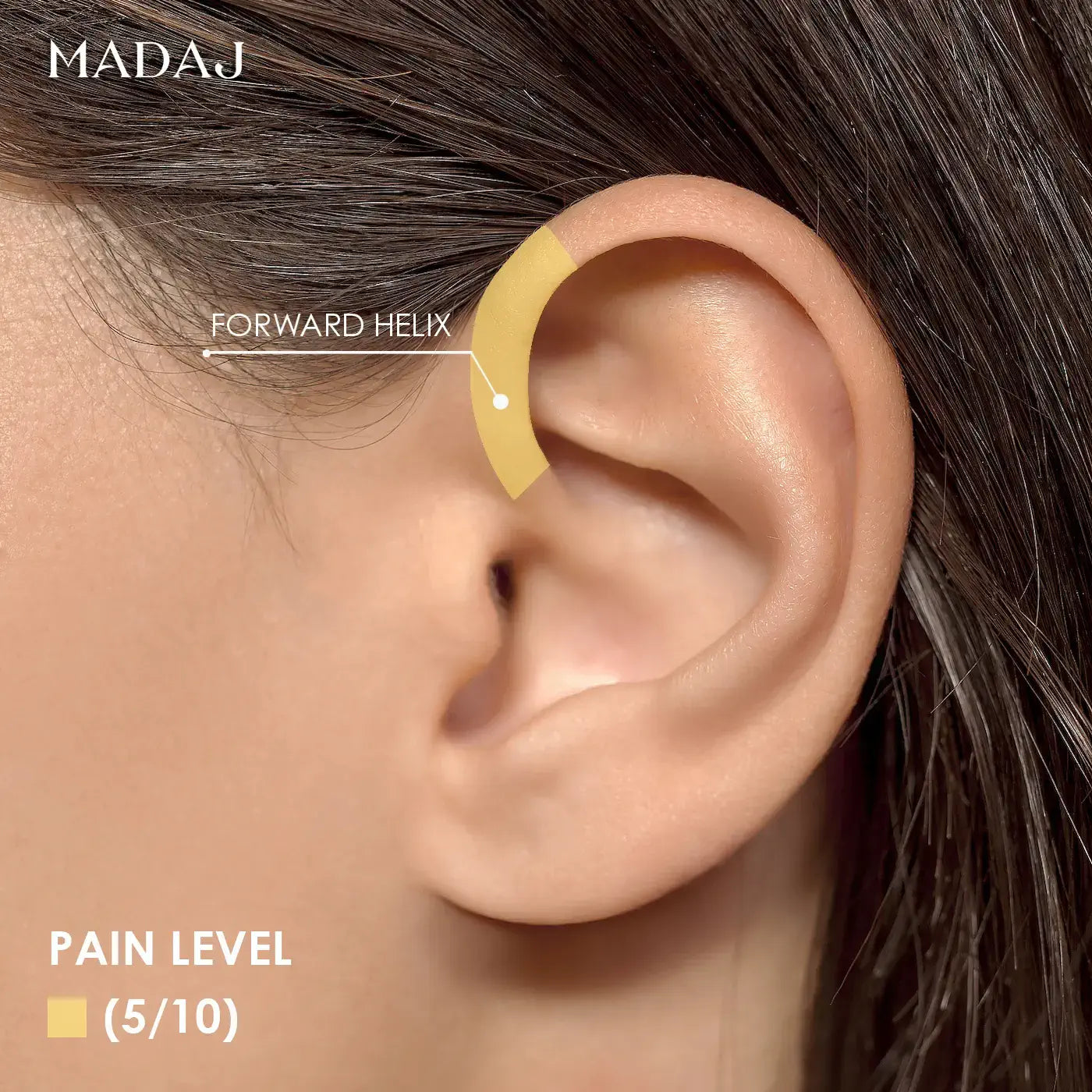
Forward Helix Piercing: 5/10
Healing time: 4 to 6 months
Positioned at the front of the ear's upper rim, just above the tragus, the forward helix involves slightly firmer cartilage than the standard helix. The pain is moderate: a sharp pinch with noticeable pressure. It is less intense than a conch or rook but a step up from a regular helix. Multiple forward helix piercings done in the same session will obviously compound the discomfort, so consider spacing them out if you are pain-sensitive.
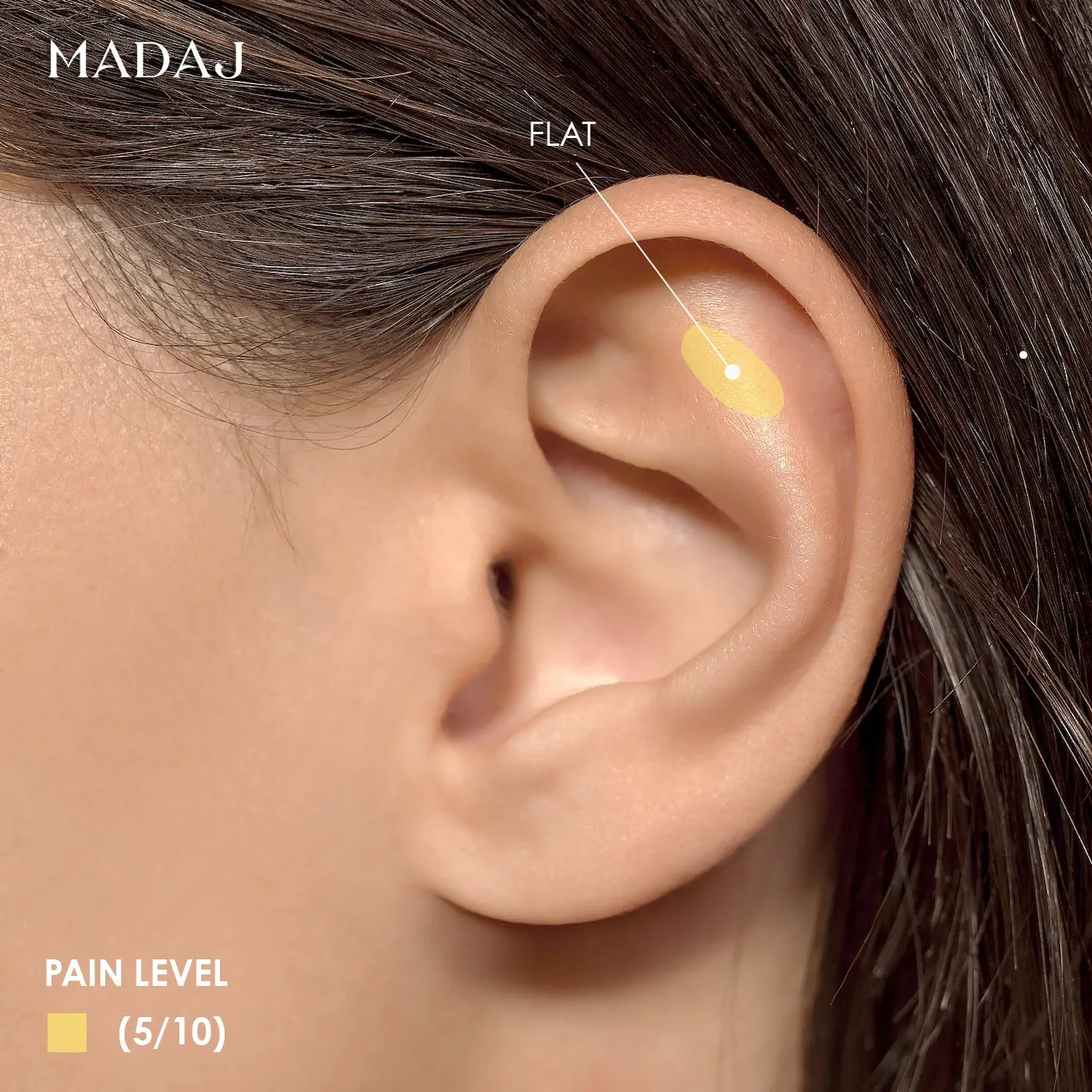
Flat Piercing: 5/10
Healing time: 6 to 12 months
The flat piercing sits on the broad, flat area of cartilage below the upper rim (between the helix and the anti-helix). The cartilage here is moderately thickand fairly uniform, so the pain is a firm, sustained pressure as the needle passes through. It is comparable to a forward helix. The flat area is popular for stacking multiple small studs, but keep in mind that sleeping on this ear during healing will be uncomfortable, so plan accordingly.

Daith Piercing: 5/10
Healing time: 6 to 12 months
The daith goes through the thick fold of cartilage above the ear canal. The tissue is dense, but many people report the pain as more of a deep, dull pressure than a sharp sting. The awkward angle can make the procedure feel slightly longer than other piercings, which some people find more uncomfortable than the actual pain level. Once it is in, soreness is typically moderate. The daith is often mentioned in connection with migraine relief, though clinical evidence for that claim remains limited.

Antitragus Piercing: 6/10
Healing time: 6 to 12 months
Located on the small raised ridge of cartilage opposite the tragus (just above the lobe), the antitragus is thicker and denser than the tragus itself. This makes the piercing noticeably more painful. The cartilage here is rigid, and the needle needs more force to pass through. The area is also relatively sensitive. Despite ranking higher on the pain scale, the antitragus heals well with proper care and creates a distinctive, eye-catching look that pairs beautifully with tragus and lobe jewelry.
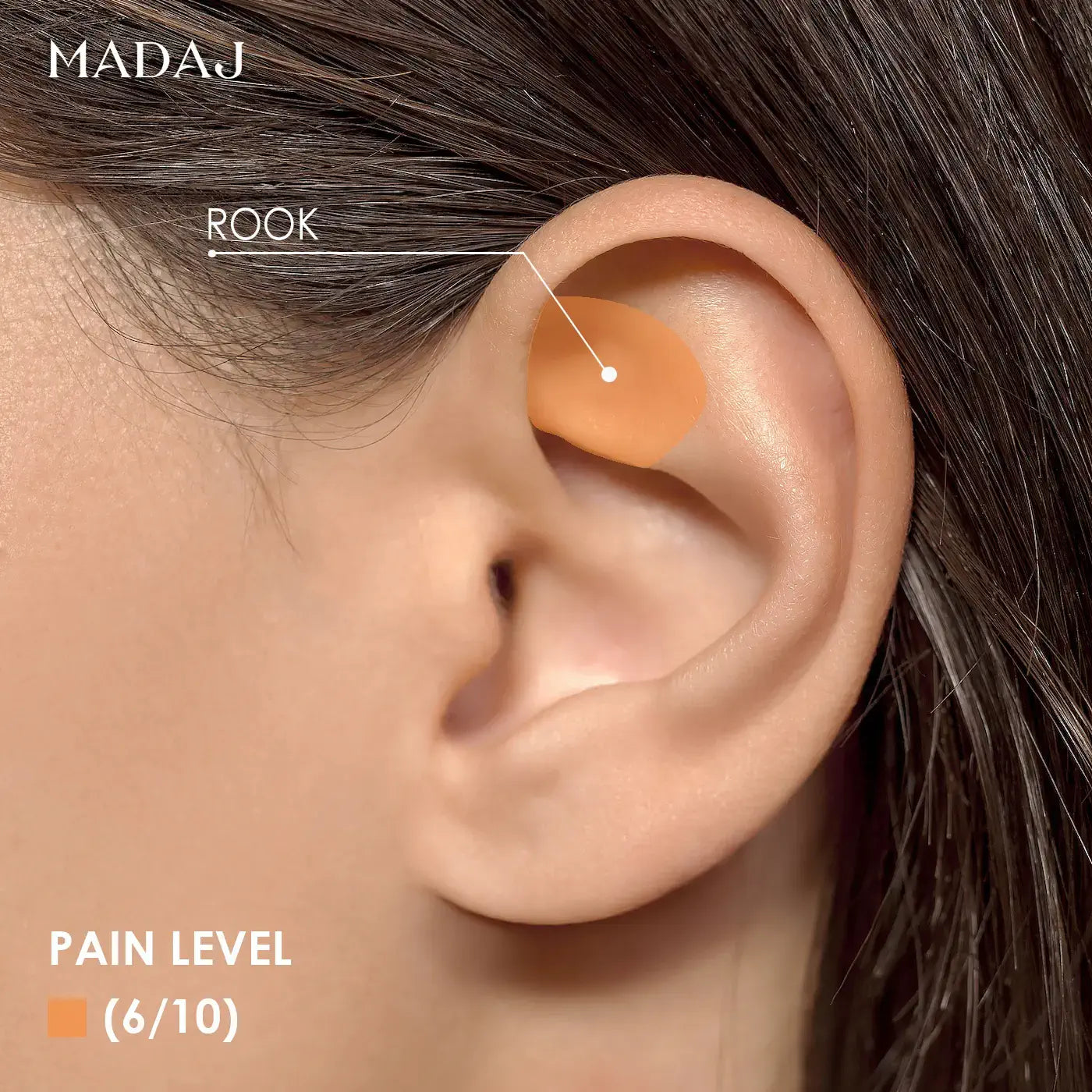
Rook Piercing: 6/10
Healing time: 6 to 12 months
The rook passes through the thick inner ridge of cartilage above the daith, in the anti-helix fold. The tissue is dense, and the piercing angle is tight, which means the piercer needs precision and a steady hand. You will feel strong pressure and a sharp pinch. The rook consistently ranks among the more painful ear piercings, but the discomfort is brief. Healing tends to be on the longer side because of limited blood flow to this part of the ear, and sleeping on it will be uncomfortable for months.
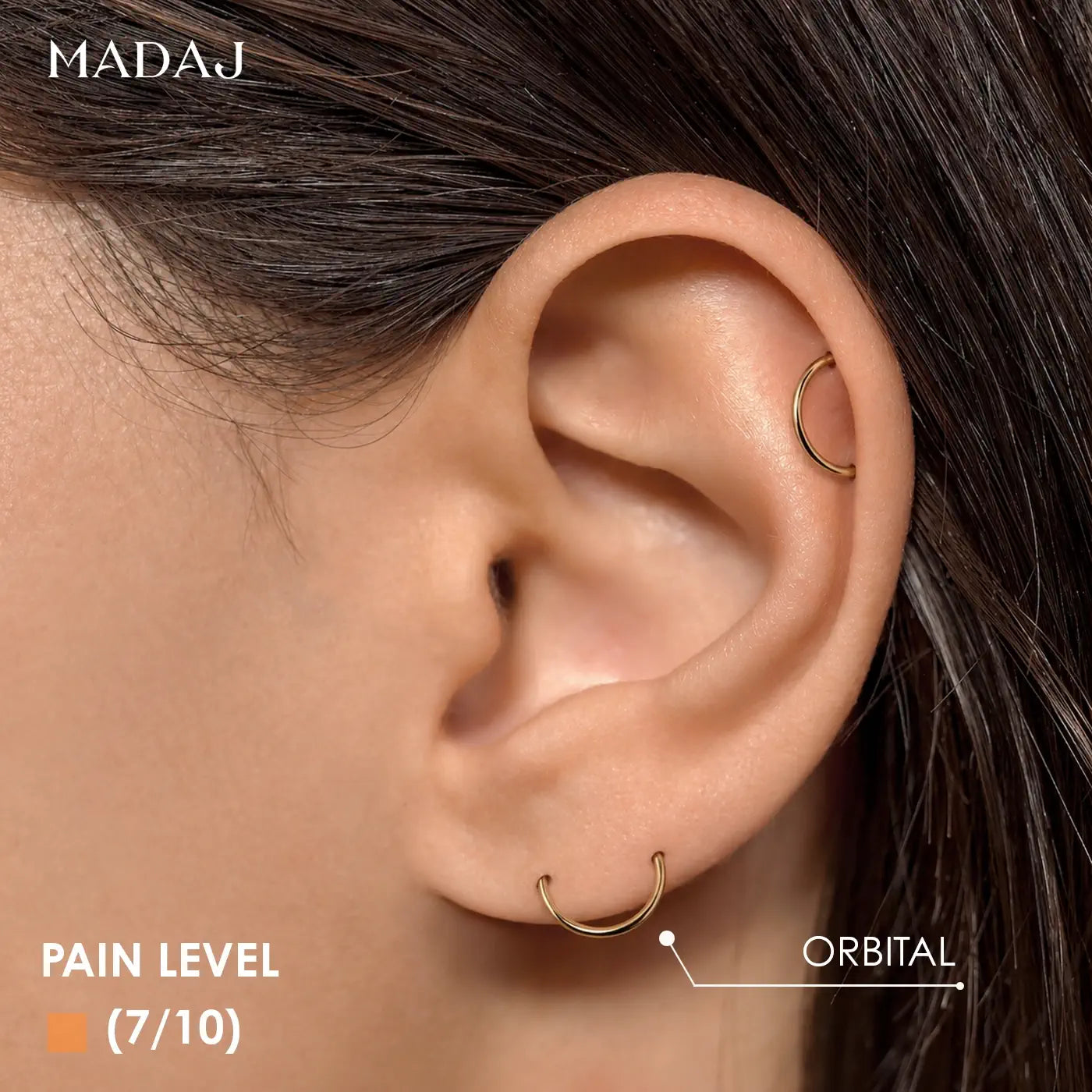
Orbital Piercing: 6/10
Healing time: 6 to 12 months
An orbital piercing involves two holes connected by a single ring, creating a hoop effect. It can be placed in various locations (lobe, helix, conch area), and the pain depends largely on where it sits. A lobe orbital is quite mild; a cartilage orbital is firmly in the 6/10 range because you are getting two piercings in one session. Most piercers will do both holes and initially insert two separate studs, swapping in the connecting ring only after both are fully healed.
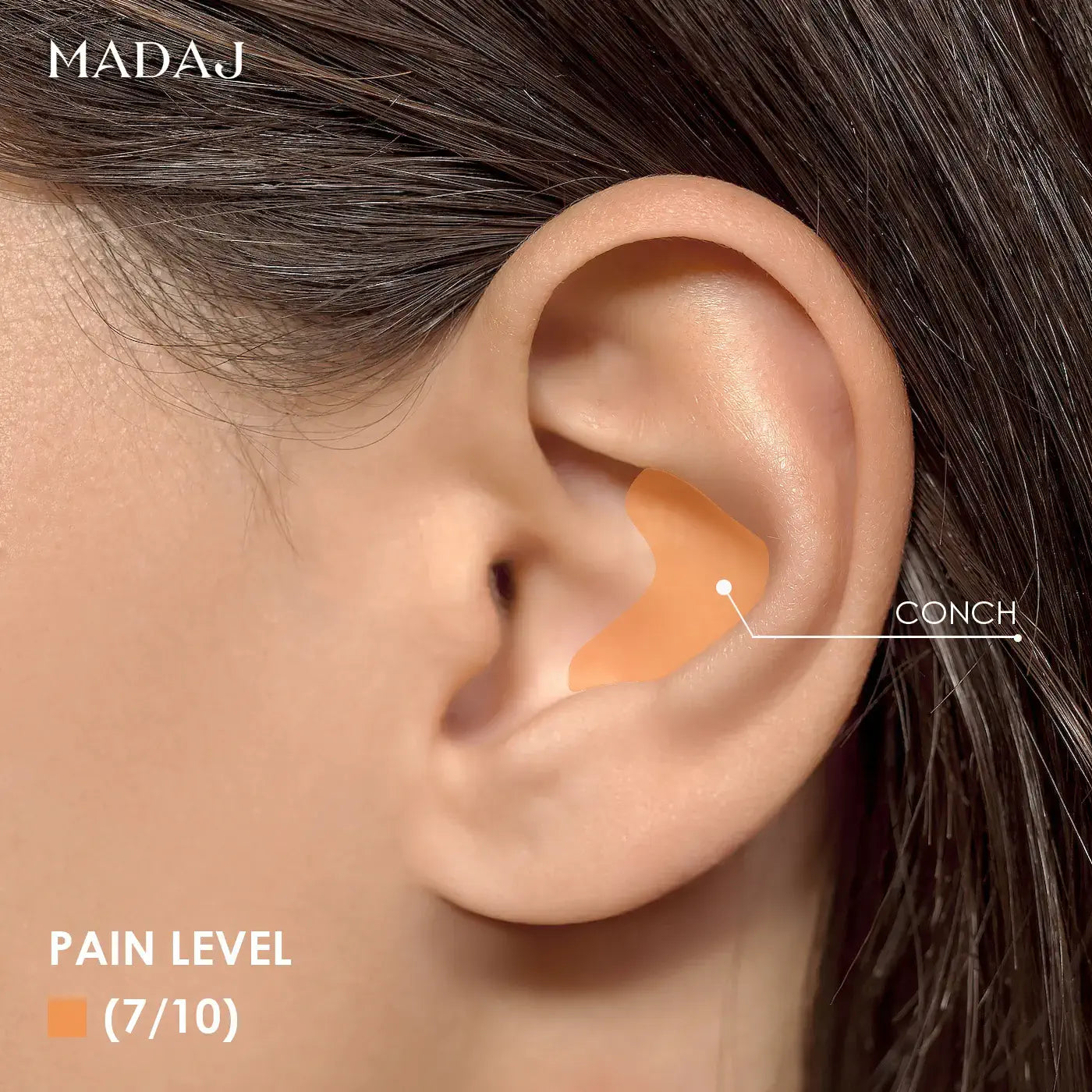
Conch Piercing: 7/10
Healing time: 6 to 12 months
The conch sits in the large shell-shaped central area of the ear, which contains some of the thickest cartilage. The needle has to push through substantial tissue, producing a strong pressure sensation and a sharp sting. It is consistently rated as one of the most painful common ear piercings. The good news: the intense part is over in seconds, and once the jewelry is in, the area settles into a manageable soreness. Conch piercings look stunning with both studs and hoops (once healed), making the brief discomfort worth it for many people.

Contraconch Piercing: 7/10
Healing time: 6 to 12 months
The contraconch is positioned in the outer conchal area, just above the lobe and below the helix. The cartilage here is comparable in thickness to the conch, which is why the pain rating is the same. It is a less common piercing, which means fewer people have reference experiences to share, but the tissue type and density make it reliably in the 7/10 range.
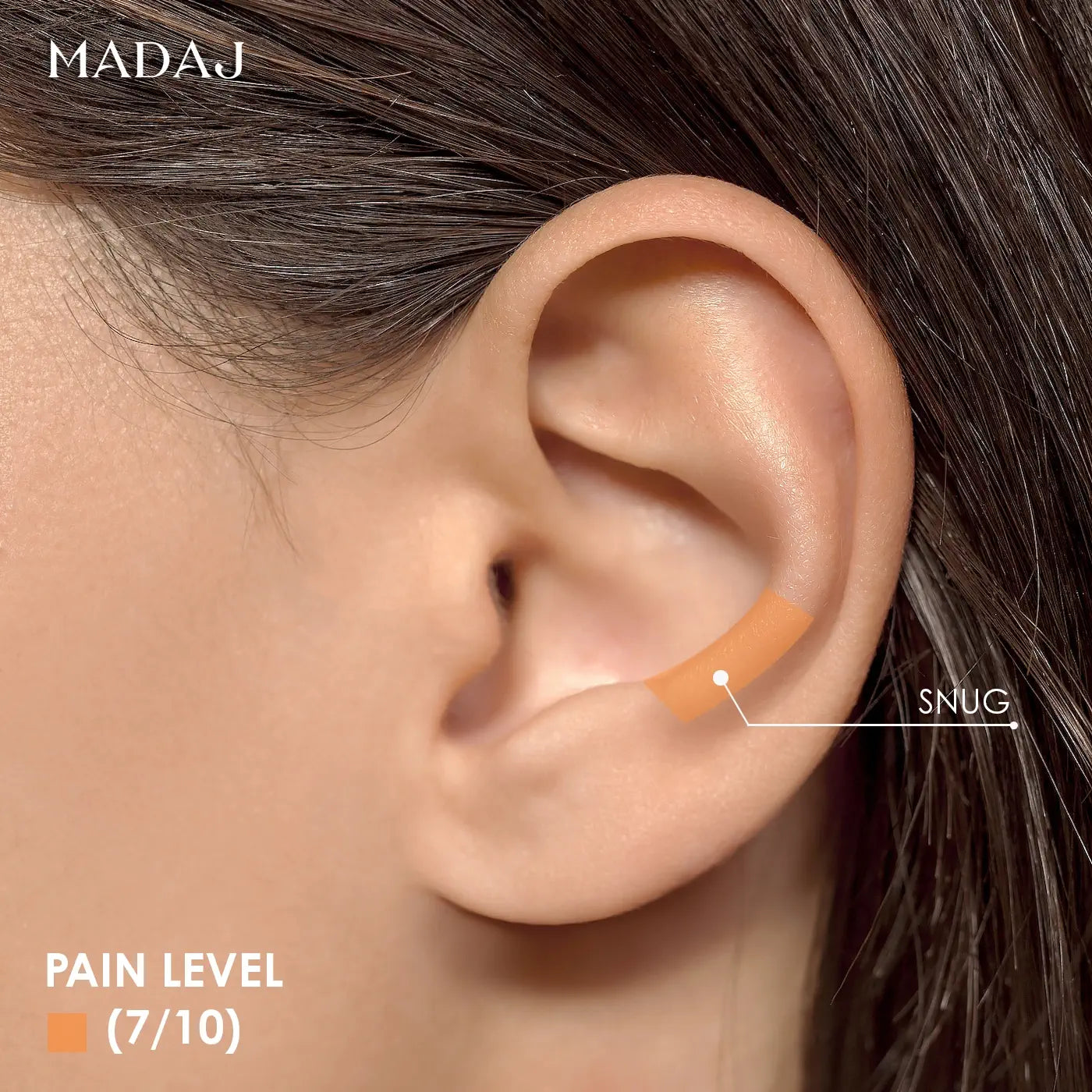
Snug Piercing: 7/10
Healing time: 6 to 12 months
The snug piercing passes horizontally through the anti-helix, the inner ridge of cartilage that runs parallel to the outer rim of the ear. This is thick, rigid cartilage on both the entry and exit sides, which makes the snug one of the more painful ear piercings. It also has one of the higher rejection rates because of the pressure the tissue puts on the jewelry. If your piercer suggests a faux snug (two separate piercings that mimic the look) instead, it is worth considering: the aesthetic is nearly identical with better healing odds.
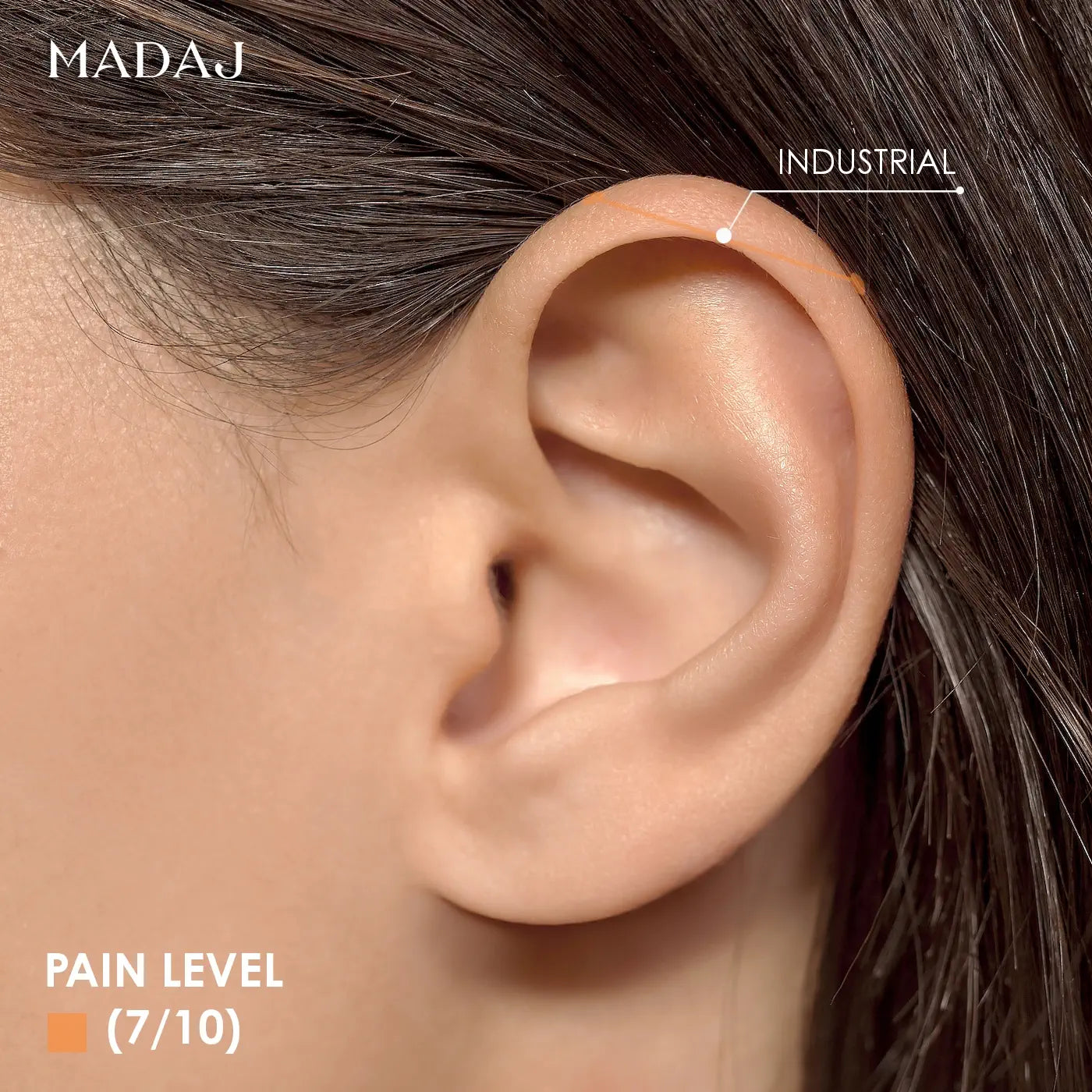
Industrial Piercing: 8/10
Healing time: 9 to 12 months
The industrial is the most painful standard ear piercing, and it earns that reputation honestly. It consists of two separate cartilage piercings (typically through the upper helix and the forward helix) connected by a single long barbell. That means two punctures through firm cartilage in the same session. The first hole is about as painful as a standard helix piercing. The second, done moments later into already-sensitized tissue, tends to sting more. The bar connecting them also creates ongoing tension during healing, which extends the recovery period and makes this piercing one of the most demanding in terms of aftercare. It is not for the faint of heart, but the result is one of the most striking and distinctive ear piercings you can get.
RANKING: LEAST TO MOST PAINFUL EAR PIERCINGS
From least painful to most painful, here is how ear piercings rank based on cartilage thickness, tissue type, and typical reported experience:
Least painful: Lobe (2/10). Soft tissue, few nerve endings, fast healing. The universal starter piercing.
Mild: Helix (4/10), Tragus (4/10). Thin cartilage, manageable pinch. Good first cartilage piercings.
Moderate: Forward Helix (5/10), Flat (5/10), Daith (5/10). Firmer cartilage, more pressure. Still comfortable for most people.
Noticeable: Antitragus (6/10), Rook (6/10), Orbital (6/10). Dense cartilage, sharper sting. These require some mental preparation.
Painful: Conch (7/10), Contraconch (7/10), Snug (7/10). The thickest cartilage areas. Brief but intense.
Most painful: Industrial (8/10). Two cartilage punctures in one session. The peak of ear piercing pain.
NEEDLE VS PIERCING GUN: WHICH HURTS LESS?
Needles. Every time.
A hollow piercing needle is razor-sharp and slices cleanly through tissue, removing a tiny core to create a smooth channel. The sensation is a quick, precise sting. A piercing gun, by contrast, uses blunt force to ram a stud through the tissue, which crushes and tears rather than cutting. The result is more tissue trauma, more swelling, a longer recovery, and paradoxically, more pain both during and after the procedure.
Piercing guns also cannot be fully sterilized between clients (their plastic components cannot withstand autoclave temperatures), and they should never be used on cartilage. The blunt force of a gun can shatter ear cartilage, leading to complications that a needle would never cause.
Any reputable piercing studio uses single-use, sterile needles exclusively. If a
studio offers gun piercings for cartilage, walk out. For lobe piercings, a needle is still the better option, but the difference is less dramatic since lobe tissue is soft enough to accommodate either method without significant complications.
HOW TO REDUCE EAR PIERCING PAIN
There is no way to make a piercing completely painless, but you can meaningfully reduce the discomfort with a few straightforward steps.
Topical numbing cream.
Lidocaine-based creams (such as EMLA or generic equivalents) are available at pharmacies, often by prescription. Apply the cream to the piercing area 30 minutes to one hour before your appointment and cover it with plastic wrap to keep it in place. This dulls the surface sensation significantly. Tell your piercer you have applied a numbing cream so they can adjust accordingly.
Stay hydrated.
Drink plenty of water in the hours before your piercing. Dehydration makes your skin tighter and more sensitive, and can also make you feel lightheaded during the procedure.
Eat beforehand.
Do not go on an empty stomach. Low blood sugar increases the risk of feeling faint, and the anxiety of hunger compounds the pain.
Breathe.
Your piercer will likely tell you to take a deep breath and exhale slowly as the needle goes through. This is not just a distraction technique: controlled breathing lowers your heart rate, relaxes your muscles, and genuinely reduces the pain you perceive.
Stay calm.
Easier said than done, but tension and anxiety make everything worse. If you are nervous, tell your piercer. A good piercer will talk you through it, work at a pace you are comfortable with, and create a reassuring environment. Bringing a friend can also help.
Choose an experienced piercer.
A skilled piercer with sharp, high-quality needles and confident technique will cause less tissue trauma and get the job done faster. This is not the place to bargain-hunt.
Avoid blood thinners.
Alcohol, aspirin, and ibuprofen thin your blood and can increase bleeding and swelling. Avoid them for at least 24 hours before your appointment. If you need pain relief afterward, paracetamol (acetaminophen) is a better choice during the first day.
FREQUENTLY ASKED QUESTIONS
The industrial piercing is generally considered the most painful standard ear piercing, rated around 8/10. It involves two separate cartilage punctures connected by a single barbell, so you experience the pain of two piercings in one session. The conch and snug piercings follow closely at 7/10 due to the thickness of the involved cartilage.
The standard lobe piercing is rated 2/10. The earlobe is soft tissue with few nerve endings and excellent blood circulation. Most people describe it as a quick pinch. It also has the fastest healing time of any ear piercing.
Yes, but the intensity depends entirely on where. Lobe piercings feel like a brief pinch. Cartilage piercings involve more pressure and a sharper sting, but even the most painful options are over in a matter of seconds. The anticipation is usually worse than the reality.
Yes, consistently. Cartilage is denser, less flexible, and has fewer blood vesselsthan lobe tissue, which means the needle requires more force to pass through and the area takes longer to heal. Lobe piercings are typically rated 2 to 3 out of 10; cartilage piercings range from 4 to 8, depending on the specific location and thickness.
The sharp pain from the needle lasts only a few seconds. Soreness, tenderness, and sensitivity during healing can persist for days to weeks, depending on the piercing. Lobe piercings feel normal within a week. Cartilage piercings may remain tender for several weeks, with occasional flare-ups if bumped or slept on.
Yes. Lidocaine-based topical creams (like EMLA) are commonly used. Apply the cream 30 to 60 minutes before your appointment. It will not eliminate all sensation, but it significantly reduces the surface-level sting. Inform your piercer that you have applied a numbing agent.
It can, especially with cartilage piercings. Pressure from sleeping on the pierced ear compresses the jewelry against the wound, causing pain and potentially slowing healing. Try to sleep on the opposite side, or use a travel pillow with a hole in the center so your ear sits in the gap without being pressed.
A needle is less painful in almost every case. Hollow needles slice cleanly through tissue, while piercing guns use blunt force that crushes the tissue. Needles also heal faster, carry lower infection risk, and are the only safe option for cartilage. Professional piercers exclusively use needles.
Start with a lobe piercing (2/10 pain, heals in 2 to 4 months). If you want your first cartilage piercing, the helix (4/10) or tragus (4/10) are the most approachable options, with manageable pain and well-documented healing processes.
Significantly. Cheap metals containing nickel can cause allergic reactions that keep the piercing inflamed, sore, and irritated for months. Implant-grade titanium and solid 14k or 18k gold (nickel-free) are the safest materials and produce noticeably less irritation during healing. Investing in quality jewelry from the start reduces both pain and complications over the entire healing period.
EXPLORE MADAJ EAR PIERCING COLLECTIONS
Every MADAJ piercing is crafted in hypoallergenic 18k gold and set with natural, certified diamonds and precious stones. Because the quality of your jewelry directly affects how comfortably your piercing heals, choosing the right piece is as important as choosing the right placement.