


Article: Conch vs Contraconch Piercing: Inner, Outer and Punched Explained
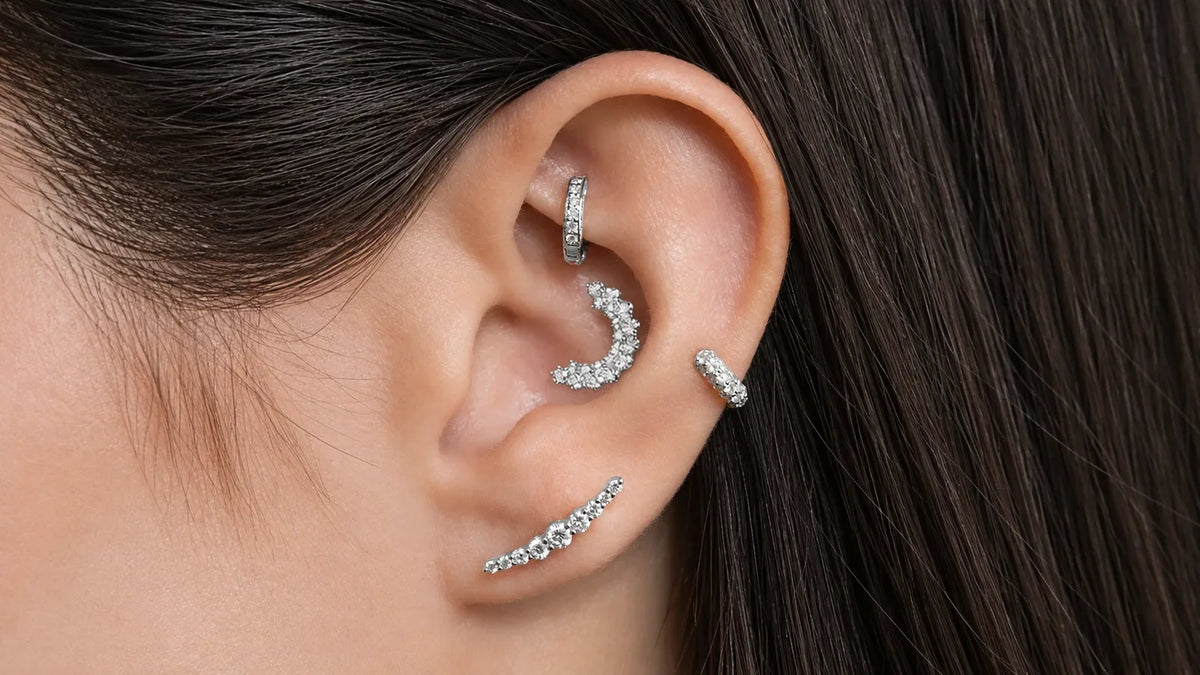
Conch vs Contraconch Piercing: Inner, Outer and Punched Explained
The word "conch" does not point to one spot on the ear. It covers a whole area of cartilage, and four piercings share the name: the inner conch, the outer conch, the contraconch and the punched conch. They sit in different places, suit different ear shapes and take different jewelry.
This guide explains each type in simple terms: where it sits, how it feels, how long it takes to heal, what jewelry fits, and who it suits. By the end, you will know which conch piercing matches your ear and the look you want.
Quick answer: Conch vs Contraconch
- Conch: pierced through the bowl-shaped cartilage in the middle of the ear, next to the ear canal. It can take a stud, and a hoop once fully healed.
- Contraconch: pierced through the raised ridge of cartilage opposite the conch, just above the earlobe and below the helix. It takes studs only.
- Inner conch: the deepest part of the bowl. It suits a single stud that sits in the center of the ear.
- Outer conch: higher, on the flatter cartilage toward the outer rim. It suits a stud, or a hoop that wraps around the rim once healed.
- Punched conch: a conch made with a dermal punch instead of a needle, for larger-gauge jewelry.
-
Pain and healing: conch and contraconch piercings both rate about 7/10 and take 6 to 12 months to heal.
What Is a Conch Piercing and What Are the Types?

A conch piercing goes through the cartilage in the middle of your ear, in the hollow next to the ear canal. The name comes from the conch shell, because this part of the ear has a similar curved shape. There are four types: inner conch, outer conch, contraconch and punched conch.
Type |
Where it sits |
How it is pierced |
Healing |
MADAJ sizes |
Inner conch |
Deepest part of the bowl, next to the ear canal | Needle | 6 to 12 months | 8 mm post while healing, 6.5 mm after |
Outer conch |
Flatter cartilage higher up, toward the rim | Needle | 6 to 12 months | 8 mm post while healing, 6.5 mm after, 11 mm hoop |
Contraconch |
Raised ridge opposite the conch, above the earlobe and below the helix | Needle | 6 to 12 months | 6.5 mm post |
Punched conch |
Inner or outer conch | Dermal punch | A year or more | Not designed for MADAJ pieces |
All MADAJ studs have a 1.2 mm (16 gauge) post, and all MADAJ hoops are 0.8 mm (20 gauge). Gauge is the thickness of the post that goes through your ear.
What Is the Difference Between a Conch and a Contraconch Piercing?

The main difference is placement. A conch piercing goes through the hollow bowl in the middle of the ear. A contraconch goes through the raised ridge of cartilage on the opposite side of that bowl. The conch can take a stud or a hoop, while the contraconch takes studs only.
Conch |
Contraconch |
|
Placement |
Hollow bowl in the middle of the ear, next to the ear canal | Raised ridge opposite the conch, above the earlobe and below the helix |
Look |
A central point in the ear, or a hoop around the rim | A small accent on the ridge, close to the face |
Jewelry |
Stud, or hoop once healed | Stud only |
Recommended MADAJ size |
6.5 mm stud post, 11 mm hoop | 6.5 mm stud post |
Anatomy |
Most ears have enough space | Needs a visible, raised ridge, so not every ear suits it |
Pain |
About 7/10 | About 7/10 |
Healing |
6 to 12 months | 6 to 12 months |
A note on names: some piercing websites use "contraconch" as another name for the outer conch. MADAJ treats them as two different placements. The outer conch sits on the flatter cartilage above the bowl, while the contraconch sits on the ridge opposite it. If you are unsure, show your piercer a photo of the look you want rather than relying on the name.
What Is an Inner Conch Piercing?
An inner conch piercing goes through the deepest part of the ear's bowl, just above the ear canal. It is the placement most people mean when they say "conch piercing." It suits a single stud that sits in the center of the ear and catches the eye from the front and the side.
- Who it suits: most ears, especially those with a deep, open bowl.
- Jewelry: a flat-back stud. Start on an 8 mm post to allow for swelling, then change to a 6.5 mm post once the swelling goes down. See the conch collection.
- Pros: sits away from hair and hats, so it snags less. A stud here works as the centerpiece of an ear stack.
-
Cons: in-ear headphones can press on it while it heals.
What Is an Outer Conch Piercing?

An outer conch piercing sits higher than the inner conch, on the flatter cartilage between the bowl and the outer rim of the ear (the helix). It is the placement to choose if you want a hoop that wraps around the edge of your ear once the piercing has healed.
- Who it suits: ears with enough flat cartilage between the bowl and the rim.
- Jewelry: a flat-back stud while healing (8 mm post, then 6.5 mm). Once fully healed, an 11 mm hoop can wrap around the rim.
- Pros: more visible from the side, and it can hold either a stud or a hoop.
-
Cons: closer to the edge of the ear, so hair, hats and scarves can catch on it more easily while it heals.
What Is a Contraconch Piercing?

A contraconch piercing goes through the raised ridge of cartilage opposite the conch, just above the earlobe and below the helix. It is one of the rarer ear placements, so it adds a small, unexpected accent to an ear stack.
- Who it suits: ears with a visible, raised ridge in this area. A piercer needs to check your anatomy first.
- Jewelry: studs only. MADAJ recommends a 6.5 mm post. See the contraconch collection.
- Pros: less common, so it stands out. A stud sits close to the ridge and keeps the look clean.
- Cons: not every ear has the right ridge, and it does not take hoops.
For procedure, aftercare and healing stages, see the Contraconch Piercing Full Guide.
What Is a Punched Conch Piercing?
A punched conch is a conch piercing made with a dermal punch instead of a needle. A dermal punch is a small, round cutting tool that removes a circle of cartilage. This creates a larger opening right away, so the piercing can hold thicker jewelry without stretching.
- Who it suits: people who want large-gauge jewelry, such as plugs or eyelets, in the conch.
- Healing: a punched conch can take a year or more to fully heal, longer than a needle piercing (Healthline).
- Good to know: because cartilage is removed, the hole is permanent and stays visible when no jewelry is worn.
-
Jewelry fit: MADAJ pieces are made for needle piercings, with 1.2 mm (16 gauge) studs and 0.8 mm (20 gauge) hoops. A punched conch is usually much larger, so MADAJ jewelry is not designed to fit it. If you plan to wear MADAJ pieces, ask your piercer for a needle piercing.
Are There Other Types of Conch Piercing?
Yes. Beyond the four main types, a conch can be pierced more than once or combined with one piece of jewelry. These are variations of the same placement rather than separate piercings.
- Upper, mid and lower conch: the conch area is large, so a piercer can place the piercing higher or lower in the bowl to suit your ear shape.
- Double conch: two piercings in the conch, either both in the inner conch or one inner and one outer. It lets you wear two studs, or a stud and a hoop once healed.
- Triple conch: three piercings in the conch. It needs a large conch area with enough space between each piercing.
-
Orbital conch: two holes joined by one hoop that passes through both. MADAJ designs do not currently fit orbital piercings.
If you want more than one conch piercing, avoid having them all done at once. Getting no more than two cartilage piercings in one session gives each one a better chance to heal well.
How Do You Choose the Right Conch Piercing?
Start with the jewelry you want to wear, then check that your ear shape and daily habits suit that placement. Your piercer makes the final call on placement after looking at your ear.
1. Choose the look
If you want... |
Choose |
|
One stud in the center of your ear |
Inner conch |
|
A hoop that wraps around the rim of your ear |
Outer conch |
|
A small, less common accent close to the face |
Contraconch |
|
Large-gauge jewelry such as plugs |
Punched conch |
2. Check your anatomy
- Bowl depth: a deep, open bowl suits an inner conch.
- Space above the bowl: enough flat cartilage between the bowl and the rim is needed for an outer conch and a hoop.
-
Contraconch ridge: a visible, raised ridge is needed for a contraconch.
3. Think about your daily habits
- Earbuds: if you wear in-ear headphones every day, ask your piercer about placing the conch slightly further from the ear canal.
- Sleep side: cartilage piercings heal better when you do not sleep on them. Consider piercing the ear you do not sleep on.
-
Hair and hats: long hair, hats and scarves catch more easily on piercings near the edge of the ear, such as the outer conch.
What Jewelry Should You Wear in a Conch Piercing?
Wear a flat-back stud while your conch heals, and wait until it is fully healed before switching to a hoop. A stud stays still, while a hoop moves more and can irritate a healing piercing.
While healing: a flat-back stud
A flat-back stud has a flat disc at the back that sits against your ear. This keeps the jewelry steady and comfortable, even when you rest your head on a pillow or wear a hat. MADAJ studs use an internally threaded screw closure: the thread sits inside the post, so only a smooth surface passes through the piercing.
Downsizing: from 8 mm to 6.5 mm
A new conch piercing starts on a longer post, usually 8 mm, to leave room for swelling. Once the swelling goes down, generally after 4 to 8 weeks, your piercer replaces it with a shorter post, usually 6.5 mm. A shorter post sits closer to the ear, snags less and looks neater. Every MADAJ piece is handmade, and each top is threaded to fit the post made with it. Order your second post together with your piercing so the two fit. Read more in the MADAJ downsizing blog.
Once healed: a hoop
Once your conch is fully healed, an 11 mm hoop can wrap around the outer rim of your ear. To check the size, your piercer measures the distance from the piercing around the edge of your ear. Ask your piercer to confirm the size before you order.
Three diamond pieces made for the conch
MADAJ makes three diamond designs specifically for the conch. All three are made to order in solid 18k gold, set with natural G to VS diamonds, and come with a Certificate of Authenticity.
|
|
Galia |
Sophia |
Ops |
Design |
 |
 |
 |
Stones |
Natural round diamonds, G to VS | Natural round diamonds, G to VS | Natural round diamonds, G to VS |
Gold |
18k white, yellow or rose | 18k white, yellow or rose | 18k white, yellow or rose |
Post |
1.2 mm (16 gauge), 5, 6.5 or 8 mm long | 1.2 mm (16 gauge), 5, 6.5 or 8 mm long | 1.2 mm (16 gauge), 5, 6.5 or 8 mm long |
Closure |
Internally threaded, flat disc back | Internally threaded, flat disc back | Internally threaded, flat disc back |
Chain charms |
Compatible | Compatible | Compatible |
All three are studs, so they can be worn while your conch heals. Choose the 8 mm post first, then add a 6.5 mm post to the same order for downsizing. They also work with MADAJ chain charms once healed, for a look that moves with you.
For more designs, gemstones and hoops, explore the full conch collection, with diamonds, black diamonds, sapphires, pink sapphires, rubies and emeralds.
Choosing a stone
The conch sits in the center of the ear, so the stone is one of the first things people notice. Diamonds and black diamonds suit an everyday look. Sapphires, pink sapphires, rubies and emeralds add color.
What Is Daily Life Like With a Conch Piercing?
A conch piercing fits easily into daily life once healed. While it heals, a few small habits help: keep pressure off it, avoid snagging, and keep it clean.
- Earbuds and AirPods: in-ear headphones sit close to the conch and can press on a healing piercing. While it heals, use over-ear headphones or wear earbuds in the other ear. Once healed, most people can wear earbuds again.
- Sleeping: sleep on the other side or on your back. A travel pillow lets you rest on the pierced side without pressure on the ear.
- Phone calls: hold the phone to your other ear or use the speaker, and wipe your phone screen often.
- Hair, hats and scarves: tie long hair back while the piercing heals, and take care when putting on hats, hoodies and scarves.
- Hair products: rinse away shampoo, hairspray and dry shampoo that land on the piercing.
-
Cleaning: clean the piercing twice a day with a sterile saline solution. Full steps are in the Conch Piercing Full Guide.
What If a Bump Appears on Your Conch Piercing?
Most bumps on a healing conch are irritation bumps, not keloids. They usually come from pressure, snagging or movement, and often settle once the cause is removed. See your piercer to find the cause rather than changing the jewelry yourself.
- Irritation bump: a small red or fluid-filled bump right next to the piercing. Common causes are sleeping on it, snagging it on hair or clothing, earbuds pressing on it, or switching to a hoop too early.
-
Keloid: a firm, raised scar that grows beyond the piercing. Keloids are much less common. Read more in the MADAJ blog on keloids.
Normal while healing: mild tenderness, light swelling, redness around the piercing in the first weeks, and a clear or whitish crust.
See a doctor if you notice: spreading redness, heat, thick yellow or green discharge, worsening pain, red streaks, or a fever. These can be signs of infection (WebMD). Do not remove the jewelry before speaking to a professional.
How Do You Style a Conch or Contraconch Piercing?
Because the conch sits in the middle of the ear, it often becomes the focal point of an ear stack. Build the rest of the stack around it.
- Inner conch stud as the centerpiece: pair it with lobe studs and a helix stud or hoop so the eye moves from the center of the ear to the edges.
- Outer conch hoop: once healed, a hoop around the rim frames the ear. Keep nearby pieces smaller so the hoop stays the main feature.
- Conch and contraconch together: a stud in each adds detail to the middle of the ear. Get them pierced in separate sessions if you are adding other cartilage piercings.
- Gold color: wear one gold color for a clean, matching look, or mix white, yellow and rose gold for contrast. MADAJ pieces come in all three.
- Chain charms: Galia, Sophia and Ops work with MADAJ chain charms, adding movement to a healed conch.
-
Avoid in the same session: a conch with a daith or rook. All three go through thick cartilage, which makes healing harder when done together. A helix, tragus or lobe pairs more comfortably.

Leave a comment
This site is protected by hCaptcha and the hCaptcha Privacy Policy and Terms of Service apply.