


Double Ear Piercing for Men: Lobe Stacking Done Right
One lobe piercing reads as a habit men have had for years. A second piercing reads as a decision. That shift, from an accessory nobody thinks about to an intentional style choice, is why double lobe piercings have become one of the more requested men's piercings of the past few years. "Double" covers more than one setup: two piercings stacked on a single lobe, or one piercing added to each ear so both lobes match. Either version raises the same practical questions: how the two piercings relate to each other, whether to get them done at once, and what jewelry actually works once there are two pieces to coordinate instead of one.
This guide walks through both versions of a double lobe piercing, the placement and timing decisions specific to each, and the jewelry pairing choices that apply either way.
Two Piercings, Two Ways to Wear Them
Before spacing or jewelry, it helps to be clear on which version of a double piercing is in play, since the two lead to different decisions from here on:
Same-lobe stacking: two piercings on one ear, one above the other. This is where spacing between the two piercing points matters most.

One per ear: a single piercing added to each lobe so both ears match, or so an already-pierced ear gets a matching piercing on the other side. Here, the main decisions are less about spacing and more about keeping both sides level and choosing whether the jewelry matches exactly or not.

Neither version is more correct than the other. Which one applies depends on whether the piercings are going on one ear or split across both, and the sections below note where that distinction changes the advice.
Why Men Are Doubling Up
A single lobe piercing has been mainstream on men for decades. A second one, whether added to the same ear or to the opposite lobe, is a smaller, lower-commitment way to build on that without moving into cartilage, which involves a longer healing process and a different level of discomfort. Lobe tissue is soft and heals faster than cartilage, which makes a second piercing a manageable step up rather than a big one. It also opens up styling options a single piercing does not: pairing two studs, mixing a stud with a small hoop, or running two matching pieces across both ears.
Same-Lobe Stacking: How Far Apart Should the Two Piercings Sit?
This section applies specifically to two piercings placed on the same ear. Spacing is the detail that decides whether same-lobe stacking looks intentional.
Piercings placed too close together can migrate, irritate each other while healing, and make it harder to insert or remove jewelry without catching the other piece. Piercings placed too far apart can end up looking like two unrelated, disconnected marks rather than a set.
A commonly used starting point is a gap of roughly 6 to 8mm between the two piercing points, measured from center to center, with the second piercing sitting slightly higher on the lobe or angled toward the ear's natural curve rather than stacked in a straight vertical line. Lobe size, thickness, and shape vary from person to person, so a piercer will typically mark both points and check them against the ear's proportions before piercing, rather than measuring off a fixed number alone.
For the one-per-ear version, spacing isn't the relevant question; placement height on each lobe is. A piercer will usually mark both ears and check them against each other before piercing, so the two piercings land at matching heights rather than measuring one ear in isolation.
Same Session or Staggered? Deciding How to Get Both Done

Some men get both piercings in the same appointment, whether that means two on one lobe or one on each ear; others get the second piercing months after the first has healed. Both approaches are common, and the right one depends on how the ear responds to piercing generally and how much the person wants to manage two healing sites at once.
- Same session: one appointment, one aftercare routine, and both piercings heal on the same timeline. This suits men who already know exactly what they want, whether that's a stacked pair or a matching piercing on each side, and don't want a second appointment later.
- Staggered: the first piercing is given time to settle, typically the 2 to 4 months it takes a lobe piercing to heal, before the second is added. For same-lobe stacking, this lets the piercer see exactly how that ear healed and adjust placement for the second piercing accordingly. For one-per-ear, it means confirming the first piercing looks and sits the way it was intended before committing the second side to match it.
There is no wrong order here. A piercer can advise on which approach suits a particular ear, or pair of ears, once they've seen it in person.
Jewelry Pairing: Identical or Complementary
Once both piercings exist, the jewelry is what turns them into a look rather than two separate decisions. There are two broad approaches: identical pairing, where the same piece is repeated in both piercings, and complementary pairing, where two related but different pieces are combined.
Identical Pairing |
Complementary Pairing |
|
Look |
Same stud or hoop repeated in both piercings | Two different but related pieces, such as a stud paired with a hoop |
Metal |
One gold tone throughout | One gold tone kept constant, shapes varied |
Gemstone |
Same stone and cut in both pieces | Same stone family in different sizes, or one plain stud with one stone-set piece |
Effect |
Deliberate, tailored, easy to plan for | More texture and movement along the lobe |
Identical pairing is the lower-maintenance option: buy one style, wear it in both piercings, and the set always matches. Complementary pairing takes slightly more planning but reads as more deliberate up close, since it shows two pieces chosen to work together rather than one design doubled.
Keeping the gold tone consistent across both piercings, yellow, white, or rose, tends to matter more to the overall look than keeping the shapes identical. Two different studs in the same gold tone generally read as a set; the same studs in two different gold tones tend to read as mismatched.
Studs or Hoops for the Second Piercing?
The first lobe piercing is almost always a stud. The second is where the stud-versus-hoop decision actually comes up, since a hoop next to a stud creates contrast, while two studs keep the look closer to matching.
Post/Wire Diameter |
Available Sizes |
Closure |
|
Stud |
1.2mm (16G) | 5mm / 6.5mm / 8mm post length | Internally threaded screw-back flat disc |
Hoop |
0.8mm (20G) | 5mm / 6.5mm / 8mm / 9.5mm / 11mm inner diameter | Clicker |
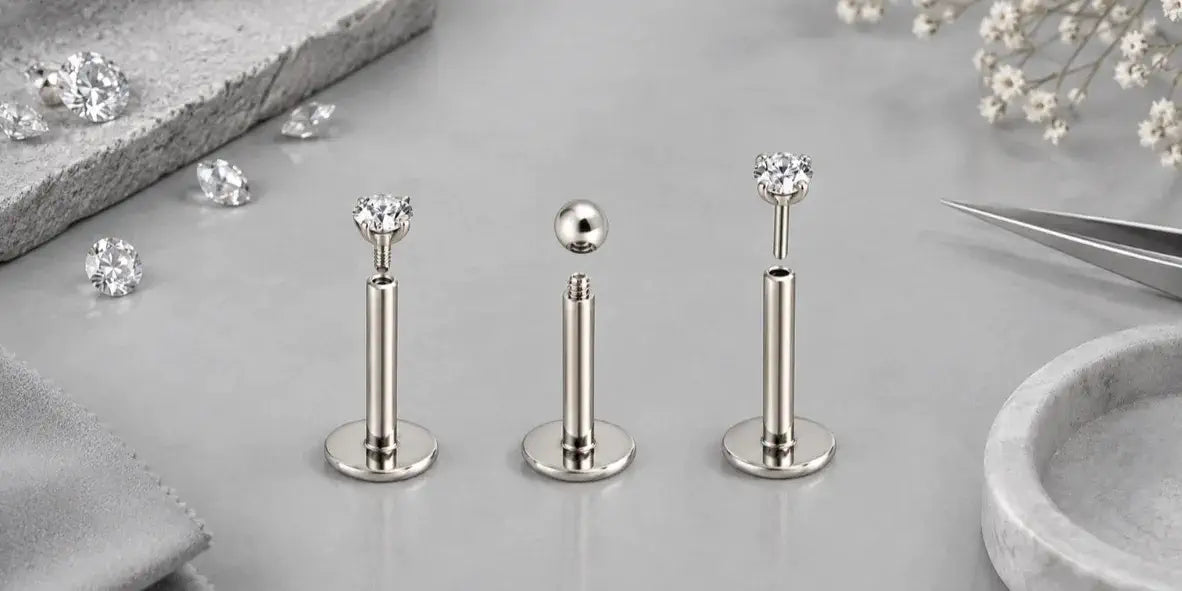
Studs use an internally threaded screw-back flat disc closure and sit flush against the lobe, which makes them a practical choice for a piercing that's still healing or for anyone who wants minimal movement day to day. Hoops use a clicker closure and sit slightly forward of the lobe, which gives more visual separation between the two piercings when that's the intended effect. A newly pierced lobe generally does better in a stud while it settles; a hoop can be introduced once healing is complete and the second piercing tolerates jewelry changes well.
A Note on Symmetry
Same-lobe stacking on one ear only tends to read as a deliberate, slightly off-center detail, since the other ear stays untouched. One-per-ear reads as more classic and balanced, closer to a standard symmetrical look. There's also a middle option: a stacked pair on one ear and a single piercing on the other, which avoids strict symmetry without looking unfinished. None of these is more correct than the others; it comes down to whether a symmetrical or an asymmetrical look fits the rest of a person's style.
Aftercare for Two Healing Piercings
Aftercare for a double piercing follows the same basic routine as a single piercing, applied to two sites at once.

- Clean both piercings with sterile saline solution, following the aftercare schedule given at the time of piercing.
- Use non-woven gauze rather than cotton products to dry the area, since cotton fibers can catch on fresh piercings.
- Avoid rotating or twisting the jewelry in either piercing while it heals.
- If both piercings are stacked on the same lobe, check that jewelry in one isn't catching on jewelry in the other, especially when sleeping or changing clothes.
- Watch for the normal signs of healing (mild redness, slight tenderness) versus signs that need attention (spreading redness, warmth, or discharge), and follow up with a piercer or medical professional if anything looks off.


Leave a comment
This site is protected by hCaptcha and the hCaptcha Privacy Policy and Terms of Service apply.