


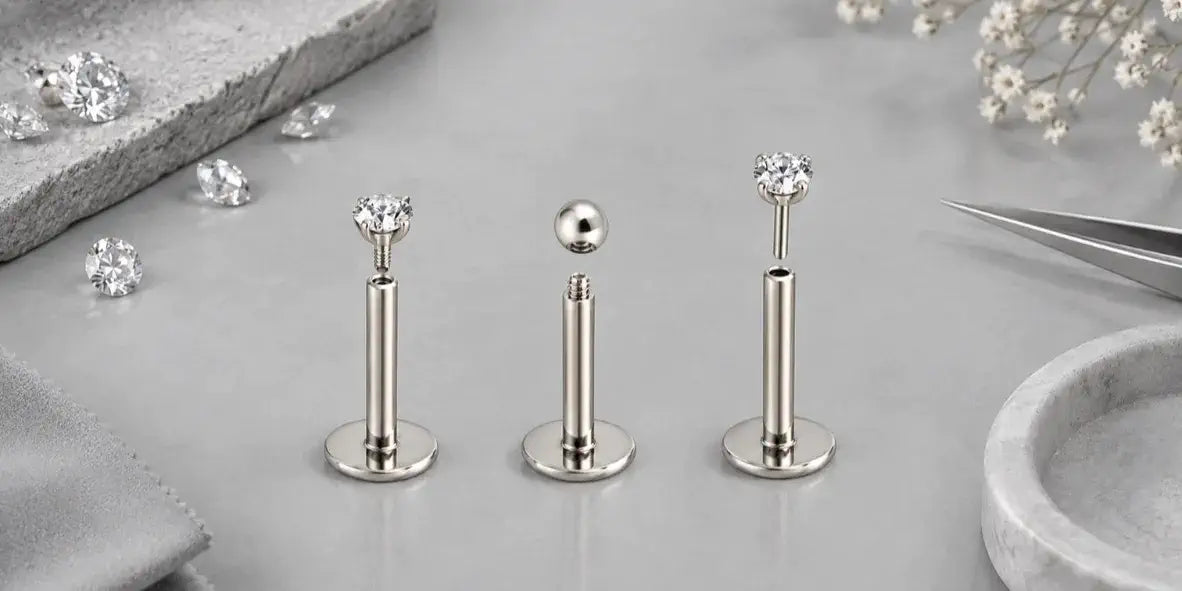
Internally Threaded vs. Externally Threaded vs. Threadless: Which Is Right for You?
Picture this: you buy the perfect stud, and two days later the decorative end is gone. It came loose somewhere between your morning routine and your evening plans, and you have no idea where.
Now picture the reverse. You are ready for a fresh look, but the end will not budge. You twist, you pull, and you start wondering if you are about to hurt your piercing.
The culprit is the same both times: the closure. It is the tiny mechanism holding your jewelry together, and it decides how secure your piece stays, how easy it is to change, and how it feels going through your piercing. Most people never learn the difference until something goes wrong.
So let's fix that before it happens. Below, we break down internally threaded, externally threaded, and threadless (push pin) jewelry, add a quick word on the classic butterfly back, and help you pick what fits the way you actually wear your jewelry. The comparison table sums it all up at a glance.
Table of Contents
- The Short Version
- What Is Internally Threaded Jewelry?
- What Is Externally Threaded Jewelry?
- Is Threadless Better Than Threaded?
- Quick Comparison
- Which One Should You Choose?
- Why Does My Piercing End Keep Coming Loose?
- Care Tips for Any Closure
- Extra Info: What About the Butterfly Back?
- Where MADAJ Fits
-
FAQs
The Short Version

- Internally threaded: the threading is inside the post. The decorative end has a small threaded pin that screws in.
- Externally threaded: the threading is on the outside of the post. The decorative end screws on over it.
- Threadless (also called push pin): no threads at all. A slightly bent pin on the decorative end is held inside the post by tension.
Now let's look at each one properly.
What Is Internally Threaded Jewelry?
Internally threaded jewelry has a hollow post with threading on the inside. The decorative end (a gemstone, a disc, a ball) has a small threaded pin attached to it. You screw that pin into the post to close it.
The key detail is what happens on the outside. The post itself stays smooth, so nothing rough passes through your piercing when you insert or remove the jewelry. Only the smooth post goes through, and the threaded part stays out of the piercing channel.
How to tighten and loosen it:
- Wash your hands well.
- Hold the post steady with one hand and the decorative end with the other.
- Turn the end to the right (clockwise) to tighten and to the left (counterclockwise) to loosen. Righty-tighty, lefty-loosey.
- Stop when it feels snug. There is no need to force it.
This is the closure used across MADAJ jewelry.
What Is Externally Threaded Jewelry?
With externally threaded jewelry, the threads are cut into the outside of the post, and the decorative end screws on over them, like a nut on a bolt.
The trade-off is that the threaded section can pass through your piercing when you insert or remove the jewelry. Those threads can feel rough, and they may cause irritation, especially in a sensitive or still-healing piercing. For that reason, many people prefer a smooth post.
You will often spot externally threaded pieces by looking at the post: if you can see fine ridges along the outside, it is externally threaded.
Is Threadless Better Than Threaded?
Not better or worse, just different. Threadless jewelry, also called push pin jewelry, has no screwing involved. The decorative end has a straight pin that is bent very slightly. You push that pin into the hollow post, and the tension keeps it in place.
How to put it in:
- Hold the post in place.
- Push the pin of the decorative end straight into the post opening until it is fully seated.
- Give the end a very gentle tug to check it holds.
How to take it out: hold the post firmly and pull the decorative end straight out. Do not twist.
If it feels loose: the pin may need a tiny adjustment to increase the tension. This takes a little practice, so if it is your first time, ask a piercer to show you.
The main difference in daily use: threaded closures are tightened by feel, while threadless closures depend on the pin's tension. Some people find one easier than the other, and that is a fair way to choose.
Quick Comparison
Internally
|
Externally
|
Threadless
|
|
Thread location |
Inside the post | Outside the post | No threads |
Attachment |
Screws into the post | Screws onto the post | Pushed in, held by tension |
Comfort |
5/5 : smooth post passes through | 3/5 : threads pass through the piercing | 5/5 : smooth post passes through |
Irritation risk |
5/5 : no threads touch the piercing channel | 3/5 : threads can catch or irritate | 5/5 : no threads touch the piercing channel |
Security |
4/5 : Secure when fully tightened, check it regularly | 4/5 : Secure when fully tightened, check it regularly | 3/5 : Depends on pin tension, may need adjusting |
User friendliness |
5/5 : familiar twisting motion | 4/5 : familiar twisting motion | 3/5 : takes some practice |
Ratings are general comparisons out of 5, where 5/5 is the most favorable. The fit and finish of the individual piece matter as much as the closure type, and your piercer can advise on what suits your piercing.
Which One Should You Choose?
Here is the simple way to think about it:
- Internally threaded is the safest, most beginner-friendly choice, whether your piercing is fresh or fully healed. The smooth post is gentle going in and out, and the screw-in motion is easy to learn.
- Threadless (push pin) suits people who already have some piercing experience and want the lowest-profile look, since it takes a bit of practice to get the pin tension right.
- Externally threaded is worth knowing about, but the exposed threads make it the least comfortable option, so it is not usually the first choice for a new or sensitive piercing.
If in doubt, ask your piercer. They can look at your piercing and recommend what suits it best.
Why Does My Piercing End Keep Coming Loose?
This is one of the most common piercing jewelry problems, and it has simple causes.
- Threaded ends: the end may not be fully tightened, or it loosens with daily movement. Check it every few days by holding the post and giving the end a gentle turn to the right. Dirt in the threads can also stop it from seating fully, so clean the pin and post when you change jewelry.
- Threadless ends: the pin may have lost tension. It may need a slight adjustment, so a piercer can help.
- Mismatched parts: ends and posts from different sources do not always fit together properly. Use matching parts to avoid a loose fit.
If an end goes missing, replace it quickly, since an open post is easier to snag.
Care Tips for Any Closure
- Wash your hands before touching your jewelry.
- Check that the end is secure regularly, not only when something feels off.
- Clean the post and decorative end whenever you change them.
- Watch for redness, swelling, pain, or discharge. If you notice these, see your piercer.
- Do not force any closure. If it will not turn or push in easily, stop and ask for help.
Extra Info: What About the Butterfly Back?

You have probably seen butterfly backs on classic earring studs. This is the small push-on back that slides onto a straight post and holds by friction.
It works differently from the three closures above: it is pressure-based and sits behind the lobe, and it can loosen or shift over time. It is common on standard earrings, but the closures above are the ones you will usually see in piercing-studio jewelry.
Where MADAJ Fits
MADAJ offers both closure types. The product name tells you which one a piece uses: "piercing" pieces have an internally threaded flat back, and "earring" pieces have a butterfly back.
Browse our diamond stud piercings for flat backs or our diamond stud earrings for butterfly backs.



Leave a comment
This site is protected by hCaptcha and the hCaptcha Privacy Policy and Terms of Service apply.