


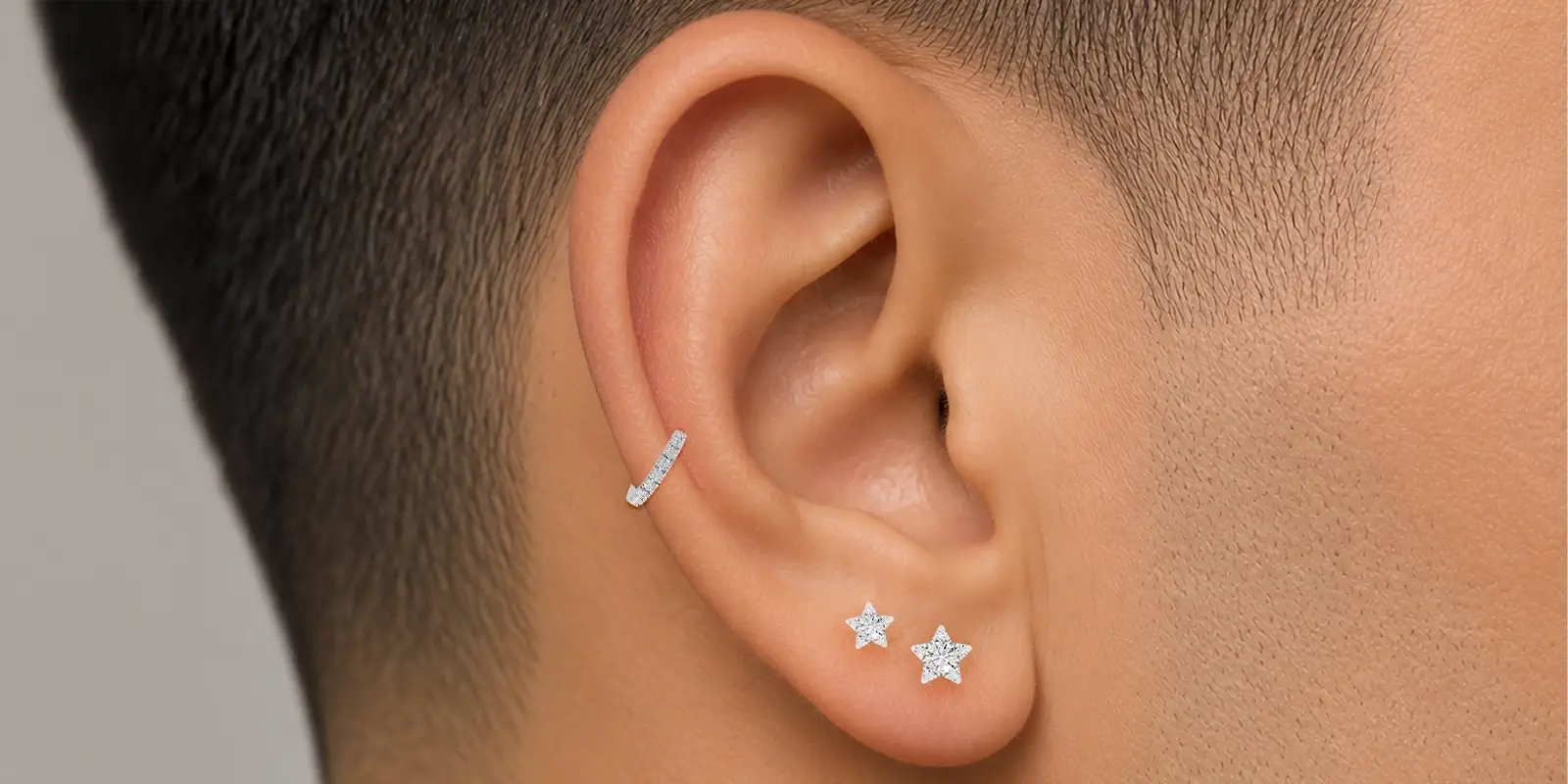
Men's Ear Piercings: A Straightforward Guide to What Works
You have already seen it. On someone you follow, someone across the room, or a photo you saved without thinking twice about why. You are not here to be convinced that men's ear piercings are a thing. You are here to figure out which one and how to get it right.
This page covers the four placements worth knowing, what each one actually feels like, how long each takes to heal, how to think about wearing more than one, how to pick a gold color that works for you, what jewelry style suits men best, how sizing actually works, and how to choose a stone that fits your personality. Honest, specific, and nothing you will need to Google twice.
The Four Piercing Placements Most Men Choose
Most men land on one of four placements. Some know immediately which one. Others narrow it down by reading about all four and trusting what feels right. Either way, here is what you actually need to know about each one.
Single Lobe
The single lobe is where most men begin, and a lot of men never feel the need to go further. Not because it is the safe option but because it genuinely works everywhere: a work meeting, a night out, a Sunday. It asks nothing of you once it heals.
At this placement, the jewelry carries the full weight of the look. A well-made stud in 18k gold reads nothing like the posts sold at a shopping mall kiosk. Same location on the ear, completely different outcome. If you are starting from zero, start here and take the jewelry seriously.

|
Healing time: 6 to 9 months |
Pain level: Low. Soft tissue, over in a second. Most men are surprised by how little it registers. |
Double Lobe
The second hole almost always comes after the first. You get the single lobe, you like it, and a few months later the space above it starts to look like a missed opportunity. That progression is so common it is practically a pattern.
What makes a double lobe look intentional rather than accidental is the relationship between the two pieces. They do not need to match exactly but they should share at least one detail: the same gold color, a similar stone size, a setting style that has something in common. A small visual connection is all it takes to make two separate pieces read as one considered decision.

|
Healing time: 6 to 9 months |
Pain level: Low. Same experience as the first. If anything, you go in knowing exactly what to expect. |
Helix
The helix runs along the upper curve of the ear through cartilage. Among ear piercing ideas for men, this one consistently shows up because of how it works visually: it is there when it matters and easy to miss when it does not. You take off a hat, push your hair back, lean into a conversation, and there it is. A quiet detail that lands differently depending on who is paying attention.
Cartilage is a different experience from soft tissue in two ways that matter. It takes longer to heal, and it responds poorly to low-quality jewelry. Nickel-free 18k gold is not an upgrade here, it is the baseline. It directly affects how smoothly that first year goes. Your piercer will walk you through aftercare. The jewelry is your decision, so make it a deliberate one.

|
Healing time: 9 to 12 months. Cartilage heals on its own schedule. Rushing it causes setbacks. |
Pain level: Moderate. Pressure more than pain. The sound, a brief crunch, tends to be more startling than the sensation. |
Tragus
The tragus is that small piece of cartilage at the front of your ear, right beside your face. Most people overlook it entirely until they see it on someone else and realize they have walked past it their whole life.
Because the placement is precise and small, it rewards jewelry that matches that energy. A 2 to 3mm stud here catches light in a way that is specific without being loud. The kind of thing someone clocks mid-conversation and cannot quite place.
One practical note: not every tragus is large enough to pierce comfortably. A good piercer will confirm this before you commit. Worth asking before you fall in love with the idea.

|
Healing time: 6 to 12 months depending on anatomy and placement depth. |
Pain level: Moderate to high. Thicker cartilage near the ear canal. Brief but the most noticeable of the four. |
A Quick Note on Stacking
Stacking is the practice of wearing multiple piercings across different placements on the same ear, and it is one of the most searched men's ear piercing ideas right now. The reason is simple: one piercing opens the door and most people eventually walk through it.
The combinations that work best for men tend to follow a logic of contrast. A lobe paired with a helix gives you something at the bottom and something at the top, which frames the ear without overcrowding it. A double lobe with a tragus keeps everything lower and closer to the face. A single lobe, a helix, and a tragus together is more committed but still reads as clean when the jewelry is consistent.
The key to stacking well is not the number of piercings. It is the relationship between them. Pieces that share a gold color, a stone family, or a setting style create a collection that looks curated. Start with one, plan the next before you get it, and build with intention rather than impulse.

| A practical note on timing: You do not have to get everything at once. Most people add one placement at a time, letting each one heal before moving to the next. This gives you a chance to see how the first piercing sits on your specific ear before committing to the ones around it. |
Stud or Hoop? Which One Is Actually Right for You
If you are trying to decide between a stud and a hoop, here is the honest take: both work. The idea that hoops look too feminine on men is a leftover assumption from a different era. A thin, well-proportioned hoop in 18k gold reads as sharp, not soft. Men have been wearing them for centuries across every culture. The stigma is fading fast, and the men who wear them have already moved on.
That said, the choice does matter in practical terms. Here is what actually separates them.
STUDS vs HOOPS: Comfortability and Style Comparison
Studs |
Hoops |
|
|

Can you mix them?
Yes. A stud in the lobe and a small hoop in the helix, or the other way around, is one of the cleaner combinations going. The contrast between the two styles adds visual interest without effort. The rules are the same as stacking: keep the gold color consistent and let the difference in style do the work
| The honest take: If you are unsure, start with a stud. It heals better, suits more situations, and gives you the option to switch later. If you already know you want a hoop, go for it — just wait until your piercing is fully healed before making the change. |
Why Closure Matters: Threaded Posts and Flat Backs
The back of your earring matters more than most people think. It is not just what holds the piece in place. It determines how comfortable the jewelry is to wear day to day, how your skin reacts during healing, and how secure your piece stays over time.
What MADAJ Uses: Threaded Posts
Every MADAJ piercing uses a threaded post system. The post screws directly into the backing with precision threading, which means it does not loosen on its own, does not slide or slip, and does not need constant adjustment throughout the day. Once it is on, it stays put.
This matters particularly during the healing period, when movement and instability are the fastest routes to irritation. A threaded post holds the jewelry in exactly the right position against the skin, which is what allows the tissue to heal cleanly around it.

Butterfly Backs and Flat Backs: Different Purposes
The butterfly back is a classic closure and a familiar choice for good reason. It is simple, quick to use, and works well for fashion earrings worn in fully healed lobes. Many people wear butterfly backs comfortably every day without any issue.

The flat back was designed with a more specific purpose in mind. For piercings, whether new or fully healed, the flat disc sits flush against the skin with no protruding edges and no pressure points. There is nothing pressing into the tissue behind the ear, which makes a real difference in comfort during long wear and throughout the healing process. For cartilage placements where the backing sits close to the skull, and for lobe piercings if you tend to sleep on your side, that flush fit is genuinely worth having.
It is less about one being better than the other and more about choosing the right closure for the context. For piercing jewelry, the flat back threaded post is the design built for the job.
| What this means for you: Every piece from MADAJ ships with a flat-back threaded post as standard. You do not need to ask for it or upgrade to it. It is how all MADAJ jewelry is made. |
Size Guide: Post Length and What to Expect During Healing
One of the most common sources of confusion after a new piercing is the post length. If your jewelry looks like it is sticking out more than expected, or if the backing seems further from your ear than it should be, that is not a mistake.
Why You Start with a Longer Post
When a piercing is fresh, the surrounding tissue swells. A longer post is used at the initial piercing appointment to accommodate that swelling without the jewelry pressing into or embedding in the skin. If the post were too short from the start, the swelling would push against the backing and create serious complications.
This is standard practice across all reputable piercers and is not specific to any particular jewelry brand. The longer post simply gives the tissue the space it needs to respond and settle.
Downsizing After Healing
Once the initial swelling subsides, typically four to eight weeks after the piercing depending on the placement and your body, your piercer will assess whether you are ready to downsize. The shorter post sits closer to the ear, looks cleaner, and reduces the chance of the jewelry catching on clothing or hair.
Most people find the downsized post is when the piercing really starts to look the way they imagined. The jewelry sits flush, the placement reads correctly, and the overall look is sharper.
RECOMMENDED POST LENGTH | MADAJ PIERCINGS
Placement |
Initial Post Length |
Downsized Post Length |
| Lobe | 8–10 mm | 5–6.5 mm |
| Helix | 8–10 mm | 6.5–8 mm |
| Tragus | 8–10 mm | 6.5–7 mm |
| Daith / Conch | 8–10 mm | 6.5–8 mm |
| Important: Do not downsize yourself. Always return to your piercer for the swap. Using jewelry that is too short before the swelling has fully resolved can cause the post to embed in the tissue. Let your piercer confirm you are ready first. |
Choosing Your Stone: More Options Than Most Men Realize
The placement and the gold color get most of the attention. The stone is where the personality comes in. MADAJ pieces are available with diamond, black diamond, ruby, sapphire, and emerald, and each of them reads differently on the ear and fits a different kind of wearer.
Diamond

The most neutral choice in the best possible sense. A white diamond catches light from every angle and works alongside any outfit, any skin tone, and any gold color. It reads as clean and considered without being loud about it. If you are not sure what stone to go with, a diamond is the hardest choice to second-guess.
Black Diamond
 Where a white diamond reflects light, a black diamond absorbs it. The effect is a deep, almost matte surface with a subtle glint that changes depending on the light. It is understated by nature and visually different from anything you would find in a standard jewelry store.
Sapphire

Blue sapphire tends to read as composed and precise, which suits most men's wardrobes without friction. It is not trying to stand out in the way a ruby does. It is more of a detail that rewards a second look. White gold or yellow gold both work well depending on whether you want the combination to feel cool and clean or warm and textured.
Emerald

Green is less expected in a piercing, which is exactly what makes it work when it is done right. An emerald stud in 18k gold is a specific choice that signals you thought about it more than most people do. It suits warmer skin tones particularly well and pairs naturally with yellow or rose gold. It is not the most common stone in a men's piercing, and that is part of the appeal.
Ruby
 Deep red, high saturation, and nothing shy about it. A ruby in a small setting on the ear works because the stone itself is doing all the talking. You do not need size when the color is that strong. It suits men who already wear color well or who want a single point of contrast in an otherwise neutral wardrobe.
Ruby pairs particularly well with yellow gold, where the warmth of the metal and the warmth of the stone amplify each other.
| The shortcut: If you are drawn to something more understated, start with a diamond or black diamond. If you want one point of color in an otherwise minimal look, ruby or sapphire. If you want the stone to be the decision, emerald. |
Which Gold Color Is Actually Right for You
Three options. None of them are wrong. Here is how to think about it without overthinking it.
 |
|
 |
| Yellow gold needs warm and direct. It works particularly well on medium to deeper skin tones because the warmth in the metal and the warmth in the skin pick each other up. It does not try to look like anything other than what it is. |
White gold is clean and sharp. If you already wear silver-toned accessories, a watch, a ring, a chain, white gold fits alongside them without friction. The most seamless match for most men who already have metal in their wardrobe. |
Rose gold is the one that surprises people. The assumption is that it will read as too soft. Then they see it in person and immediately understand why it works. It suits fair to medium skin tones particularly well and carries a warmth that neither yellow nor white gold quite occupies. |
| The shortcut: Look at the metal you already wear and match the tone. If you wear nothing, yellow gold is the most forgiving starting point across a range of skin tones and one of the harder choices to regret later. |
All MADAJ Piercings are 18k Nickel-Free Hypoallergenic Gold.
What to Know Before Going to Your Appointment
Know your placement.
Your piercer can advise, but they work faster and better when you already have a direction. If you are between two options, narrow it down to those two and let the piercer help you make the final call based on your ear anatomy.
Decide on your jewelry in advance.
This is the part most people leave too late. The jewelry you start with affects the entire healing process, not just how it looks on day one. Nickel-free 18k gold is the standard worth starting with. If you are ordering from MADAJ, your piece is made to order, so factor in enough time to have it ready before your appointment.
Know what to ask.
A good piercer will cover aftercare with you, but ask specifically about what to avoid, what products to use, and what signs to watch for during healing.
Eat something before you go.
Blood sugar drops are a real thing during piercings, especially for first-timers. It sounds small but it makes a difference.
Aftercare in Plain Terms
Your piercer will give you specific instructions and those take priority over anything general. But here is a straightforward breakdown of what to do and what to leave well alone during the healing period.
Do this:
- Clean the piercing twice a day with a sterile saline solution. That is all it needs.
- Let water run over it naturally in the shower. No scrubbing, just rinsing.
- Sleep on the opposite side or use a travel pillow with a hole in the center to avoid putting pressure on a new cartilage piercing.
- Check occasionally that the jewelry is sitting correctly, not too tight against the skin and not loose enough to move around on its own.
-
Be patient. Healing takes longer than it looks like it does from the outside.
Avoid this:
- Touching the piercing with unwashed hands. Hands are the number one reason piercings get irritated.
- Rotating or twisting the jewelry. This is old advice that causes more harm than good.
- Swimming in pools, hot tubs, or open water during the early healing period. All of them introduce bacteria.
- Applying alcohol, hydrogen peroxide, or antibacterial soap directly to the piercing. These are too harsh and slow healing down.
- Getting hair products, cologne, or skincare near the piercing. Anything with fragrance or chemicals is an irritant.
-
Changing the jewelry before the piercing is fully healed, no matter how healed it looks on the surface.
| What normal healing looks like vs. what is not: Some tenderness, mild swelling, and occasional crustiness around the jewelry in the first few weeks is completely normal. Prolonged redness, heat, throbbing pain, or discharge after the initial period is not. If any of those show up, go back to your piercer before you try to fix it yourself. |
Made to Order: What That Means for You
Most piercing jewelry is made in bulk, sitting in a warehouse waiting to be shipped. MADAJ works differently. Every piece is made to order in nickel-free, hypoallergenic 18k gold, yellow, white, or rose, with gemstones including diamond, black diamond, ruby, sapphire, and emerald.
Made to order means the piece is produced specifically for you after you place it. It takes more time than pulling something off a shelf, and that is exactly the point. The quality of a piece made with that kind of intention is different from one produced at volume, and you will feel that difference in how it sits, how it wears, and how long it lasts.
Every piece ships with a flat-back threaded post as standard. You do not need to request it. It is how all MADAJ jewelry is built.
MADAJ ships worldwide and shipping is always free. If you have a placement in mind and want help choosing the right piece for it, send a message through the website. That is what we are here for.
What Men Are Actually Thinking Before Getting a Piercing
If you are taking your time on this decision, you are not overthinking it. Most men go through the same set of questions before they commit. Here are the ones that come up most often.
"Will it suit me?" This is the first one, almost always. The honest answer is that a small, well-chosen stud in 18k gold suits the overwhelming majority of men. It is not about face shape or age or style. It is about the scale of the piece and the quality of the jewelry. A 2mm diamond in a bezel setting is not asking your face to do anything dramatic.
"What will people at work think?" Less than you are probably imagining. A single lobe stud reads as a personal style choice, not a statement. It is unremarkable in the best way. The men who have been most surprised are the ones who got it and realized no one said anything at all — they just noticed it quietly and moved on.
"Is it going to be a hassle to maintain?" Once it heals, almost none. The healing period requires a bit of attention, mostly keeping it clean and leaving it alone. After that, the only thing you need to think about is the jewelry itself, and with a threaded flat-back post it stays put without any daily effort.
"Am I too old for this?" No. Men in their 30s, 40s, and 50s get pierced at MADAJ. The age question usually comes from worrying about perception, not a genuine belief that there is an expiry date on this kind of thing. There is not.
"What if I regret it?" Very few men do. The more common experience is wondering why they waited. And if it turns out it is not for you, a lobe piercing closes cleanly once you take the jewelry out. Nothing about it is permanent.
"Will it hurt badly?" It will be over before the question finishes forming. A lobe piercing takes a second. A cartilage piercing takes a second and a half. Most men describe it as less than they expected, which is not reassurance, it is just accurate.
| The pattern: Most men who hesitate eventually get it and immediately stop hesitating. The decision is almost always harder than the experience. |
The best ear piercing for men is not the most popular one or the one that looked good on someone else. It is the placement that suits your ear, the gold that suits your skin, and the piece you are still wearing without thinking about it ten years from now.
Everything at MADAJ is made to order in nickel-free, hypoallergenic 18k gold. We ship worldwide and shipping is always free. Not sure where to start? Send us a message and we will help you figure it out.

Leave a comment
This site is protected by hCaptcha and the hCaptcha Privacy Policy and Terms of Service apply.