


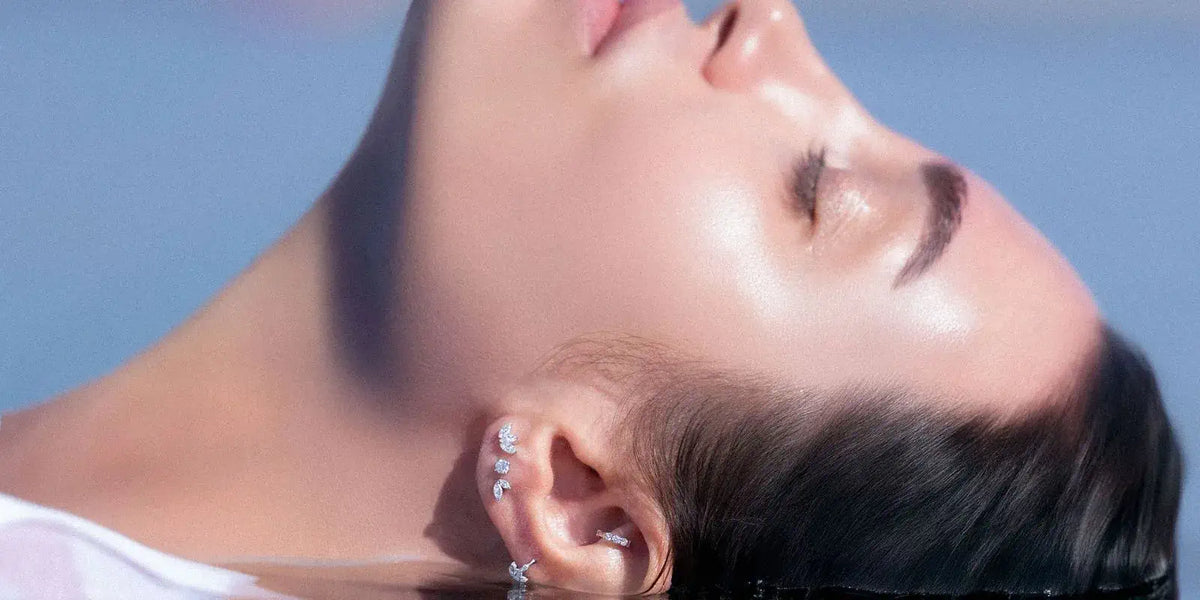
Your First Piercing After Lobes: How to Pick Your Next One
Lobe piercings are almost always the starting point.
They heal relatively quickly, work with almost every jewelry style, and are easy to build on. But once your first lobes are settled, the next question is usually the same: what piercing should come next?
For most people, the answer leads toward cartilage.
Cartilage piercings usually take longer to heal than lobes, often need more careful aftercare, and work best with jewelry that suits both your anatomy and the placement.
This ear piercing guide compares the most popular options after lobes, including helix, forward helix, flat, conch, tragus, and upper lobe piercings. It covers healing times, pain levels, anatomy, starter jewelry, and styling options so you can choose a placement that looks good and heals well.
Table of Contents:
-
Why Your Next Piercing Matters
-
Meet the Helix Piercing
-
Other Great Options After Lobes
-
How to Choose the Right Ear Piercing Placement
-
Common Mistakes Beginners Make
-
FAQs
Why Your Next Piercing Matters
A lobe piercing is relatively forgiving.
The tissue is soft, the healing is faster, and the jewelry options are broad. Moving into cartilage is a different experience, and the placement you choose will affect how long you are in the healing phase, how comfortable it is day to day, and how it fits into your overall ear piercing guide vision.
Building a Balanced Ear
Your next piercing does not exist in isolation. Even if you are only thinking about one new placement right now, it is worth considering where it sits in the context of your ear as a whole.
A helix piercing at the outer rim reads very differently from a tragus or a conch piercing closer to the ear canal. Some placements anchor a future ear stack. Others work best as standalone statements.
If ear piercing types feel overwhelming at this stage, start simple: choose one placement that genuinely appeals to you and suits your anatomy. You can always build from there.
Thinking Beyond What Is Popular Right Now
Trends in ear piercing ideas move quickly. What reads as fresh today can feel dated in a couple of years, and a cartilage piercing is not something you remove and forget about the way you might wear an earring. The most satisfying piercings are the ones chosen because they genuinely suit the wearer.
Meet the Helix Piercing
If you ask a professional piercer what they recommend for someone moving beyond lobe piercings for the first time, the helix piercing comes up consistently. There are good reasons for that.
What It Is

A helix piercing is placed through the outer rim of the upper ear, the curved fold of cartilage that runs from the top of the ear downward. It is one of the most visible ear piercing placements and one of the most versatile, because the helix offers several distinct positions: a single helix toward the top, a mid-helix further down the rim, or a forward helix near the front of the ear.
Each position reads slightly differently and pairs well with different jewelry styles, which is part of why the helix piercing works so well as a foundation for future ear piercing ideas.
Why It Works for Beginners
- The helix is beginner-friendly for several reasons:
- The outer cartilage rim is generally well-defined across most ear shapes, making it suitable for a wide range of anatomies
- It is less prone to snagging than placements closer to the ear canal
- It heals at a predictable pace with consistent aftercare
- It does not interfere with sleeping as much as inner ear placements like the daith or conch
- The jewelry options are extensive giving you creative range from day one
In terms of pain, a helix piercing is typically rated moderate, more than a lobe piercing but manageable. The cartilage does not have the same nerve density as softer tissue, so the sensation is sharp and brief rather than prolonged.
Healing Expectations
A helix piercing takes between 6 and 12 months to fully heal, though many people feel comfortable at around the 4 to 6 month mark. Full healing takes longer than it feels. Changing jewelry too early is one of the most common reasons helix piercings become irritated or develop complications.
Cleaning twice daily with a sterile saline solution is the standard aftercare. Avoid rotating the jewelry, applying creams or oils near the piercing site, and sleeping directly on the piercing during the healing phase. For a full breakdown, our piercing aftercare guide covers everything you need to know.
Styling Possibilities
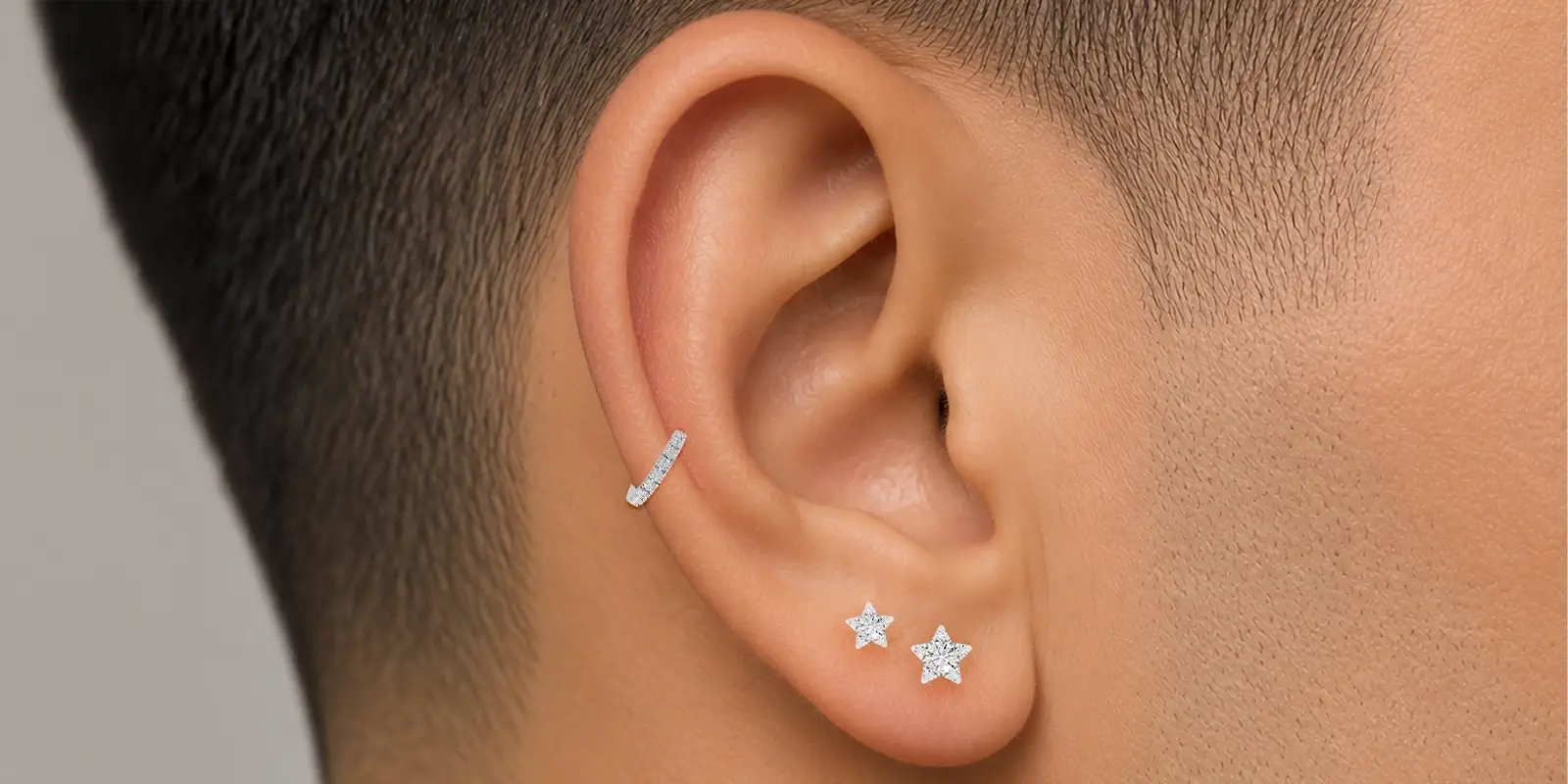
The helix piercing pairs naturally with lobe jewelry and works across minimal and statement aesthetics. A single flat back stud keeps things clean and refined. A small clicker hoop adds movement.
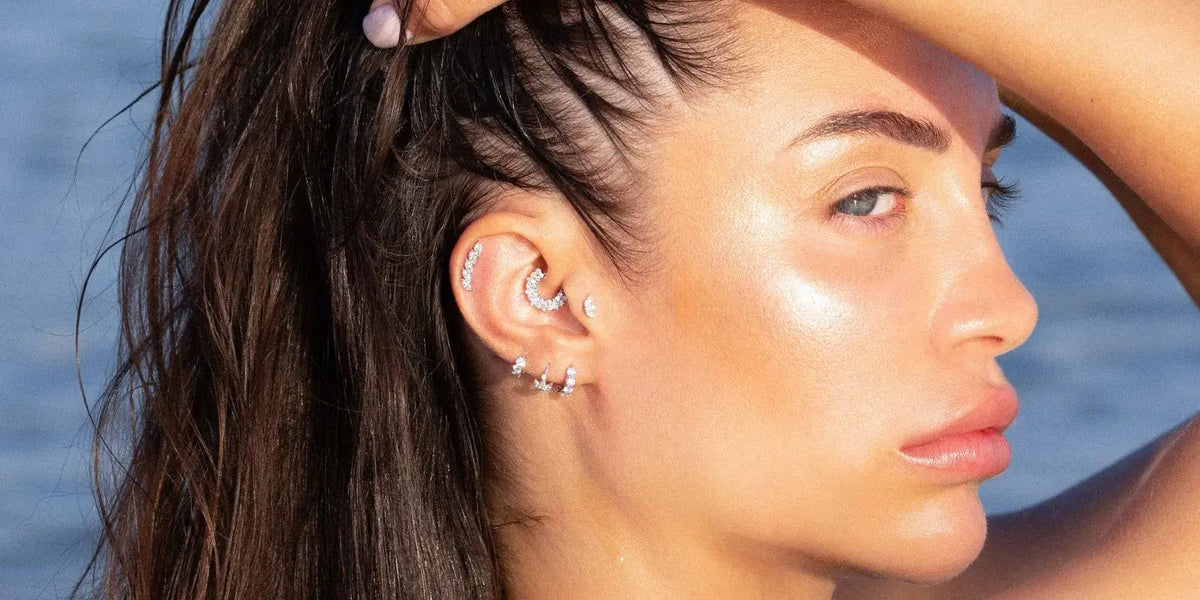
A cluster or charm piece makes the helix a focal point. As a first cartilage piercing, it gives you a strong visual anchor to build from without demanding a specific direction.
Other Great Options After Lobes
The helix is a strong starting point, but it is not the only option. Depending on your anatomy, lifestyle, and the look you are going for, one of these ear piercing types may suit you better.
Forward Helix

The forward helix sits at the front of the outer cartilage rim, close to where the ear meets the head. It is a more subtle placement than a standard helix piercing, less visible from the front and more of a quiet detail when wearing your hair up. It suits smaller, more delicate jewelry and is a good option if you want something understated.
Healing is similar to the standard helix: Healing is similar to the standard helix: 6 to 12 months with consistent aftercare. Anatomy matters here, a well-defined forward cartilage fold makes this placement more comfortable and easier to heal.
For forward helix hoops, MADAJ's size guide suggests around 5 mm as a general reference, though the right size depends on your anatomy and personal preference. Some choose a closer 5 mm fit, others prefer 6.5 mm or 8 mm for more presence.
Flat Piercing

The flat piercing sits on the flat upper cartilage area of the ear, inside the helix rim. It is a slightly more involved placement in terms of healing, flat cartilage can be slower to fully recover than the outer rim, but it offers a distinctive look that photographs particularly well.
Flat back labret studs are the standard jewelry for this placement. The flat surface area means you can wear slightly larger decorative tops without them looking out of proportion. If your ear piercing ideas lean toward a stacked, gallery-style look, the flat piercing adds strong visual interest in the upper ear.
Conch Piercing

The conch sits in the inner bowl of the ear, the curved, cupped area between the outer rim and the ear canal. It is one of the more striking placements because of its central visibility, but it comes with a longer healing commitment (typically 9 to 12 months or more) and requires sufficient depth in the inner ear to sit correctly.
This is not always the best first cartilage piercing for beginners simply because of the healing demands and the fact that sleeping on it can be uncomfortable for an extended period.
That said, for the right anatomy, it is a beautiful and versatile placement. Our conch piercing guide covers everything you need to assess whether it suits your ear.
Tragus

The tragus is the small triangular flap of cartilage that sits directly in front of the ear canal. It is compact, precise, and adds a detail that reads well at close range, a subtle but considered addition to any ear piercing placement plan.
Not every ear has a tragus large enough to pierce comfortably. A piercer will assess this quickly. For those with suitable anatomy, healing typically takes 6 to 12 months. Flat back studs are the most practical jewelry choice, especially during healing.
See our tragus piercing guide for sizing and placement specifics.
Upper Lobe

Often overlooked in favour of cartilage, the upper lobe is one of the most underrated next steps after a first lobe piercing.
It heals faster than any cartilage placement, is significantly less sensitive, and opens up a lot of layering potential without the longer healing commitment.
If you are drawn to the look of a layered lobe, adding a second and third lobe piercing before moving into cartilage is a practical and visually rewarding approach. Our lobe piercing guide covers placement spacing and jewelry sizing for multiple lobe piercings.
For better guide, here’s a quick comparison of all the options above:
Placement |
Pain Level |
Healing Time |
Best For |
Beginner-Friendly |
| Helix | Moderate | 6–12 months | Most anatomy types | Yes |
| Forward Helix | Moderate | 6–12 months | Subtle, minimal looks | Yes |
| Flat | Moderate | 9–12 months | Gallery-style stacks | With guidance |
| Conch | Moderate–High | 9–12+ months | Statement placement | Less so |
| Tragus | Moderate | 6–12 months | Defined tragus anatomy | With guidance |
| Upper Lobe | Low | 3–6 months | Layered lobe looks | Very much so |
How to Choose the Right Ear Piercing Placement
Choosing between ear piercing types comes down to more than preference. A few practical factors will shape which placement actually works for you, and how smoothly it heals.
Your Ear Anatomy
Some placements require specific anatomical features to work. A tragus needs to be large enough to pierce. A forward helix needs a defined cartilage fold. A conch needs sufficient inner bowl depth.
You cannot always tell from photos or references whether a particular ear piercing placement will work for your specific ear, that is what a consultation with a professional piercer is for.
Your Lifestyle
Think about your day-to-day life.
Do you wear headphones regularly?
Certain inner ear placements can be uncomfortable with in-ear headphones during the healing phase.
Do you wear helmets, hats, or headgear? Outer rim placements like the helix can catch on these.
Do you work in an environment where facial or ear jewelry is restricted? These things are worth factoring in before you commit.
How You Sleep
Sleeping directly on a healing piercing is one of the most common sources of irritation. If you are a side sleeper, outer rim placements like the helix on your non-dominant side are more manageable than inner placements like the conch.
A travel pillow can help you sleep without putting pressure on the piercing, but it is worth choosing a placement that gives you some flexibility.
Your Jewelry Preferences
Different placements suit different jewelry styles. If you love the look of small, refined studs, almost any placement will accommodate that.
If you want to wear hoops, some placements give you more flexibility than others. Knowing what you want to wear ultimately helps you choose where to pierce.
Common Mistakes Beginners Make
Most piercing complications are preventable. These are the patterns that come up most often with first-time cartilage clients.
Choosing Based Only on What Looks Good on Someone Else
Piercing inspiration is everywhere, and it is genuinely useful for identifying styles you respond to. But a reference photo shows someone else's anatomy, someone else's healed piercing, and someone else's jewelry choice.
What works beautifully on one ear may not translate directly to yours. Use references as a starting point for the conversation with your piercer, not as an exact blueprint.
Underestimating How Long Cartilage Takes to Heal
A cartilage piercing that feels fine at three months is not necessarily healed. Cartilage tissue rebuilds slowly, and the internal healing process continues long after the surface looks settled.
Changing jewelry too early can reset progress and introduce irritation bumps that take months to resolve. Trust the timeline your piercer gives you, not how the piercing feels on a good day.
Buying Jewelry From Unvetted Sources
Low-quality metals in a healing piercing are a direct route to prolonged healing and allergic reactions.
For any new or healing cartilage piercing, it is recommended to use nickel-free, hypoallergenic solid 18k gold. Avoid plated pieces, mystery alloys, or anything that cannot confirm its material composition.
MADAJ jewelry is made in hypoallergenic 18k gold, with options including yellow gold, white gold, and rose gold.
Clear material information matters because plated jewelry, coated metals, nickel-heavy alloys, and unknown compositions can increase the risk of irritation, especially while the piercing is still healing.
Neglecting Aftercare Once the Piercing Feels Settled
Aftercare tends to drop off as the piercing starts to feel comfortable. That is exactly when people run into problems. A helix piercing at five months may feel completely fine, but the cartilage has not finished rebuilding.
Keep cleaning consistently, twice daily, no more and no less, until you have hit the full recommended healing timeline. When you are ready to switch to new jewelry, have the change done by a professional piercer rather than doing it yourself.

Leave a comment
This site is protected by hCaptcha and the hCaptcha Privacy Policy and Terms of Service apply.