


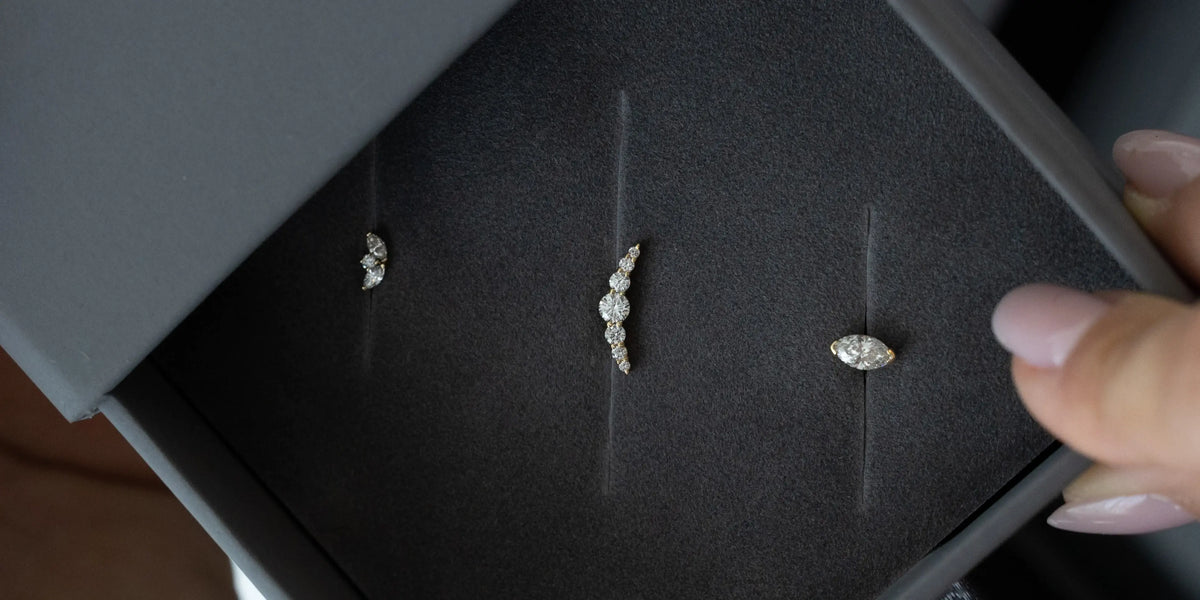
3 Ear Piercings: Best Combinations and How to Style a Minimalist Ear Stack
Choosing the right 3 ear piercings combination means they don't have to feel like a starting point you'll outgrow. Chosen well, they can be the whole look, nothing missing, nothing extra.
Not everyone wants a full ear stack with a dozen placements to plan and heal. Some people want exactly two or three ear piercings, styled with intention, worn confidently, and done.
A minimalist ear stack is genuinely underrated. Enough to create real visual rhythm. Small enough to plan properly, heal without complication, and style with a handful of well-chosen pieces instead of a drawer full of jewelry.
The real challenge isn't picking three placements you individually like. It's choosing ones that work together.
Quick answer: For a true beginner, three lobe piercings is the easiest and most forgiving combination, all lobe, fastest healing, no cartilage pain to manage. If you want a bit more range without much added difficulty, lobe, helix, and tragus is the next step up: low to moderate pain, spans the ear without overloading one area, and heals within 6 to 12 months. Full breakdown and more combinations below.
Table of Contents
-
Why 2-3 Piercings Is the Sweet Spot
-
What to Consider Before Choosing Your 3 Ear Piercings
-
The Best Combinations at a Glance
-
How to Style a 2-3 Piercing Combination
-
Ear Piercing Sizing for a Small Stack
-
Common Ear Piercing Combination Mistakes
-
Checklist Before You Commit
-
FAQs
Why 2-3 Piercings Is the Sweet Spot
Two piercings can feel unfinished once healed. A full ear stack, on the other hand, usually means five or more piercings healing at the same time. That's a longer overall timeline and a bigger jewelry budget spread across every placement.
Three sits in between. Enough for visual rhythm. Small enough that every piece is easy to plan, style, and afford.
Fewer healing sites means less to manage at once. Spacing and jewelry pairing are far easier to plan for two or three placements than for six or seven, since every piece gets room to actually be seen.
A minimalist ear stack is also a natural stopping point, not a placeholder. Plenty of people build a two- or three-piece combination, live with it for months, and only expand once they know how it feels in daily life. If that becomes your direction, MADAJ's guide to building the perfect ear stack picks up right where this one leaves off.
What to Consider Before Choosing Your 3 Ear Piercings
Anatomy

The depth of your conch, the size of your tragus, and the shape of your cartilage all affect what's realistic. A piercer can confirm what works for your ear before you commit.
Ear piercing pain levels, placement by placement

Lobe is the easiest start, barely a pinch for most people. Helix and tragus sit around 4 out of 10. Daith runs a touch higher, closer to 5 out of 10. Conch and contraconch are the firmest of the bunch, both frequently rated around 7 out of 10. None of it is severe, cartilage pain is sharp and brief rather than prolonged, but knowing roughly where each placement sits helps you choose a combination that matches what you're actually comfortable with.
Timing

Healing speed varies a lot by placement, and that alone can decide your order and pace. Lobes typically heal in 2 to 4 months, giving you a finished piece to build around while cartilage progresses. Cartilage takes longer, generally 6 to 12 months, and is more sensitive to friction and interruption, so if your combination includes two cartilage placements, staggering them by a few weeks to a couple of months tends to heal more comfortably than doing both at once. Some people want everything done quickly; others space it out. Both are valid, it comes down to how much simultaneous healing you want to manage.
Visibility and lifestyle
Daith and rook read subtle; tragus and double helix are immediately visible. If your workplace has restrictions on visible jewelry, or you just prefer a quieter look, it's worth factoring in before you commit to a combination.
The Best Combinations at a Glance
Triple Lobe
The Classic Combo. Beginner-friendly.

The true starting point for anyone new to piercing, and the one that never goes out of style. All three sit on the lobe, so there's no cartilage pain, no cartilage healing time, and no risk of overdoing it on a first round. Easy to style with a vertical row of studs, or build in a small hoop once the top hole is healed.
Lobe, Helix & Tragus
The Curated Combo. Reliable.

The most popular combination once you're ready to bring cartilage into the mix. Three different zones, so nothing competes for space or overloads one stretch of cartilage while healing. Easy to style with a stud, a compact hoop, and a flat back.
Double Lobe + Helix
The Easiest Upgrade. Low-effort.

Already have one lobe piercing? A second lobe plus one helix is the lowest-friction way to go from basic to intentional. Both lobes heal in the same window, no mismatched timeline, and the helix adds cartilage interest without months of extra patience.
Lobe, Daith & Helix
A Balanced Look. Understated.

The daith sits deep in the ear's inner fold, quiet and almost hidden next to the more visible helix. One subtle, one prominent, anchored by a lobe, that contrast is the whole point.
Lobe, Forward Helix & Tragus
A Structured Set. Architectural.

The forward helix sits close to the face and adds definition without bulk. The tragus grounds the look from the opposite side. Set against a lobe, the three points feel placed, not scattered.
Helix, Conch & Tragus
An All-Cartilage Combo. Bold.

What happens when you skip the lobe entirely? This. The conch does the heavy lifting, framed by the helix and tragus on either side. All three sites are cartilage, so this asks more of your healing, but the result looks unmistakably composed.
Lobe, Contraconch & Antitragus
A Sculptural Combo for Healed Ears. Distinctive.

The most distinctive option here, better as an addition than a starting point. The contraconch and antitragus sit close together on the same cartilage, so this works best once your lobe is already healed. Confirm anatomy compatibility with a piercer first.
Two Lobes + One Cartilage
A Layered Alternative. Gentle.
Dimension without diving straight into cartilage-heavy healing. Two lobes handle the layering, one cartilage piece, helix or conch, lifts it beyond a simple pair of studs.
Weigh pain, healing speed, and visibility against what you actually want to wear day to day, and one or two of the combinations above will usually already fit. If not, the underlying formula still holds: one grounding placement, one moderate placement, no more than one higher-commitment cartilage site.
How to Style a 2-3 Piercing Combination
Single-Tone or Two-Tone, and Repeat One Element

Fewer pieces means each one carries more visual weight, so two quick rules go a long way: pick one dominant gold tone (yellow, white, or rose) as your anchor, and repeat at least one element across the pieces, the same tone, a diamond shape, or a related motif. A second tone can work as a single accent at one placement, but keep it to one clear point of contrast rather than an even mix.
One tone. One repeated detail. One clear point of contrast. That's the whole formula.
Play With Shape, Not Just Tone
A stud at the first and second lobe placement, an ear climber on the helix, that's gentle contrast without overcomplicating a small combination. The same shape at every placement flattens the look, so let each piece take a different form: a stud for structure, a hoop for movement, an ear climber for a quiet line that follows the curve. For more shape pairings across different placements, browse MADAJ's ear piercing ideas and compositions.
Let One Piece Lead, and Leave Room to Breathe

Not every piece needs equal detail. A shaped or gemstone-focused stud can act as the focal point while a smaller, quieter stud supports it nearby, one piece carrying more visual weight, with the rest kept simple, usually reads better than three pieces all competing for attention. And if two adjacent pieces are both visually heavy, the combination can look cluttered even when each piece is beautiful alone, so a simpler piece between them gives the eye somewhere to pause.
Working with just two pieces? Distance can do the same job. A lobe and a helix don't need to sit close together, the open space between them becomes part of the composition, with the lobe anchoring the lower ear and the helix creating a separate point of interest higher up.
Can You Mix Gemstones?

Yes, if that's the effect you want. Repeating one stone family keeps things quiet. One colored gemstone as the accent against a calmer base adds contrast. Mix gemstone colors, keep the gold tone consistent, mix gold tones, keep the gemstone consistent. Pick one axis of variation, not two.
Ear Piercing Sizing for a Small Stack
With only two or three pieces, a hoop that's slightly too big or a stud that sits a touch off can throw off the whole combination, there's nothing else on the ear to draw the eye away from it. In a bigger stack, one off-sized piece can hide among a dozen others. Here, it's often the first thing people notice.
MADAJ's ear piercings size guide gives placement-based starting points for post length and hoop diameter, but anatomy varies enough that a chart is only ever a starting point. When in doubt, especially for the helix or other cartilage placements, a professional piercer can confirm the right fit faster than guessing from measurements alone.
Common Ear Piercing Combination Mistakes
-
Picking placements with no visual relationship. Chosen individually, without considering how they read together, they rarely come together as a combination.
-
Ignoring anatomy fit. Not every combination suits every ear, especially pairings like contraconch and antitragus. Confirm with a piercer first.
-
Getting everything done in one sitting when staggering would heal better. Multiple simultaneous healing sites, especially cartilage, is a heavier load than most people expect.
Checklist Before You Commit
- Choose the two or three piercings you want to emphasize
- Decide which piece carries the most visual presence
- Repeat at least one element, gold tone, gemstone, or shape
- Use scale or silhouette difference for contrast
- Confirm the jewelry type suits each placement
- Confirm post length or hoop diameter for your anatomy
- Leave room for preference, minimal can be subtle or simply well-edited


Leave a comment
This site is protected by hCaptcha and the hCaptcha Privacy Policy and Terms of Service apply.