


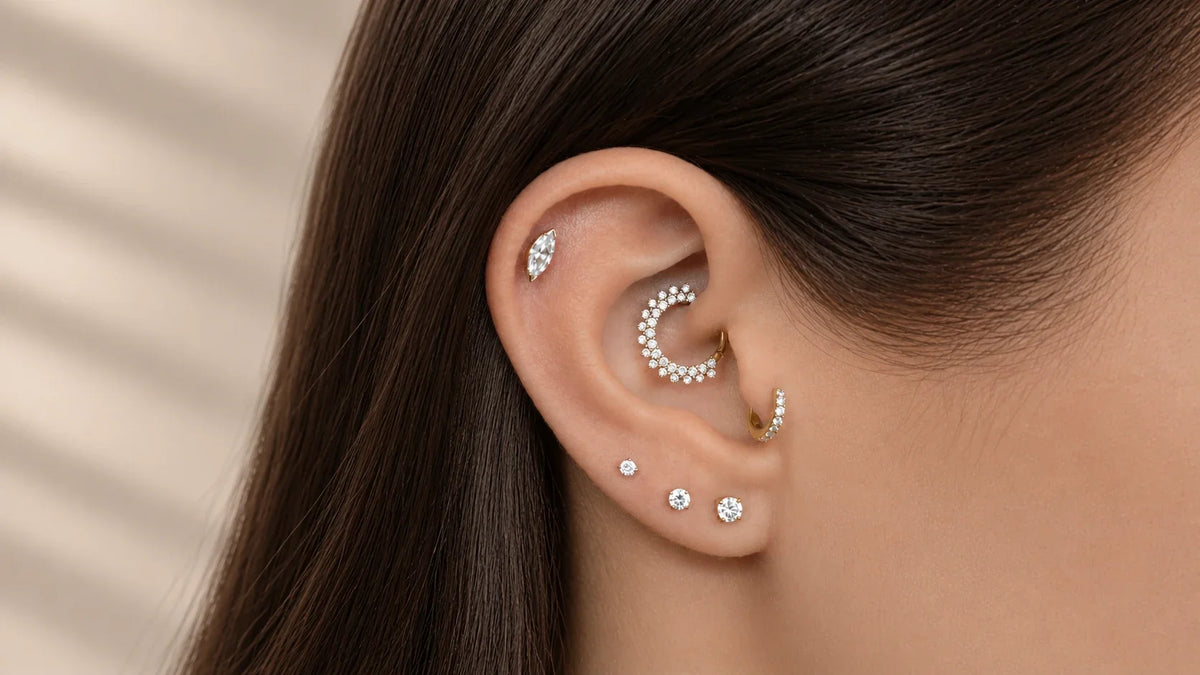
Hypoallergenic vs Nickel-Free Earrings for Sensitive Ears: What Actually Makes Them Safe
You bought the earrings because the label said hypoallergenic. A week later, your lobe is itchy, red, and warm to the touch.
This happens more often than most people expect, and the problem usually isn't your skin. It's the label. "Hypoallergenic" sounds like a promise, but in most countries it carries no legal definition at all. "Nickel-free" is a different claim entirely, and knowing the difference between the two is the fastest way to stop guessing every time you buy a new piece.
Below, you'll find what each term really guarantees, which metals sensitive ears tolerate, how to verify a brand's claims, and why MADAJ builds every piercing in nickel-free 18k gold.
In This Guide:
- What Does Hypoallergenic Mean on Earrings?
- What Does Nickel-Free Mean?
- Hypoallergenic vs Nickel-Free Earrings: What's the Difference?
- Why Do Earrings Irritate Sensitive Ears?
- Which Earring Metals Are Safe for Sensitive Ears?
- Is 18k Gold Hypoallergenic?
- Why Does MADAJ Use 18k Gold for Every Piercing?
- How to Check If Earrings Are Really Nickel-Free
- Hypoallergenic Earrings for New Piercings vs Healed Ears
- What to Do If Your Ears React to Earrings
- Frequently Asked Questions
What Does Hypoallergenic Mean on Earrings?
Hypoallergenic means "less likely to cause an allergic reaction." It does not mean reaction-free, and no regulator checks the claim before it appears on a label.
The U.S. Food and Drug Administration states plainly that no federal standards or definitions govern the term "hypoallergenic", and that it can mean whatever a company wants it to mean. That FDA guidance was written for cosmetics, but jewelry is in the same position: there is no test a pair of earrings has to pass before a brand can call it hypoallergenic.
In practice, the word is used for very different things:
- Solid gold with a clean, nickel-free alloy
- Stainless steel that still contains nickel
- Base metal with a thin plated coating that wears off within months
All three can carry the same label. That is why the word alone tells you very little about what is actually touching your skin.
What Does Nickel-Free Mean?
Nickel-free is a measurable specification. It refers to how much nickel a metal releases onto the skin, and in Europe that amount is capped by law.
Under the EU's REACH regulation, any post that passes through a pierced ear or other piercing must release less than 0.2 micrograms of nickel per square centimeter per week. Earrings and other jewelry worn in prolonged skin contact have a limit of 0.5 micrograms. The UK applies the same limits under UK REACH.
Two details matter here:
- Nickel-free usually means "below the legal release limit," not literally zero nickel. Testing measures how much nickel migrates out of the metal, because that is what triggers a reaction.
- The stricter limit applies to piercing posts. A post sits inside the skin channel, so regulators hold it to a lower threshold than the decorative front of an earring.
A brand that says "nickel-free" should be able to tell you what alloy it uses and what standard it meets. A brand that only says "hypoallergenic" has no obligation to tell you anything.
Hypoallergenic vs Nickel-Free Earrings: What's the Difference?
Hypoallergenic is a marketing description. Nickel-free is a technical claim that can be tested and verified.
|
|
Hypoallergenic |
Nickel-Free |
What it means |
Less likely to cause a reaction | Nickel release below a set limit |
Legal definition |
None | EU and UK REACH release limits |
Who decides |
The brand | A measurable test standard (EN 1811) |
Can you verify it |
Not from the label alone | Yes, through alloy disclosure and testing |
Guarantees no nickel |
No | No, but release is capped at trace levels |
Useful for nickel allergy |
Only if the brand explains the alloy | Yes, it addresses the most common jewelry allergen directly |
The two terms can overlap. Jewelry that is genuinely nickel-free is also hypoallergenic in any meaningful sense. The reverse is not always true.
Why Do Earrings Irritate Sensitive Ears?

In most cases, the cause is nickel. The American Academy of Dermatology lists nickel as one of the most common causes of allergic contact dermatitis, and jewelry is the usual way people first come into contact with it.
According to the Mayo Clinic, a nickel allergy is an immune reaction that typically causes an itchy rash where the metal touches the skin, and it is most often linked to earrings and other body-piercing jewelry. Common signs include:
- Itching and redness around the piercing
- Dry, scaly, or darkened patches of skin
- Small bumps or blisters in more severe cases
The Cleveland Clinic notes that a nickel allergy can develop at any point, even after years of wearing the same metal without a problem, and that once it develops, it does not go away. A pair you wore comfortably for months can start reacting later.
The other frequent cause is plating. Gold-plated and gold-tone earrings have a thin layer of gold over a base metal. As that layer wears through, the base metal underneath, often containing nickel, ends up against your skin. MADAJ covers this in more detail in Why Cheap Piercing Jewelry Causes Infection (And Turns Skin Green).
Which Earring Metals Are Safe for Sensitive Ears?

Solid gold at 14k or above with a nickel-free alloy is a dependable choice for sensitive ears. The lower the gold content and the thinner the surface layer, the higher the risk.
One point surprises most people:
"Surgical steel" still contains nickel. The name refers to its use in medical instruments, not to being nickel-free. People with a strong nickel allergy may still react to it.
Is 18k Gold Hypoallergenic?

Solid 18k gold is well suited to sensitive ears, provided the remaining 25% of the alloy is nickel-free.
Pure gold does not react with skin. The issue is never the gold itself but what it is mixed with. Pure 24k gold is too soft to hold its shape in a piercing, so jewelers combine it with other metals for strength. In 18k gold, those other metals make up 25% of the piece. In 14k, they make up 41.5%. In 10k, more than half.
That is why karat alone does not settle the question:
- Yellow and rose gold are typically alloyed with silver and copper, which rarely cause reactions.
- White gold comes down to the metal underneath and the finish on top. MADAJ white gold is solid nickel-free 18k gold, finished with rhodium, a platinum-group metal that gives it a bright white shine. The gold beneath the finish stays nickel-free, so the metal against your skin remains gentle as the finish softens with wear.
At MADAJ, every piece, in yellow, white, and rose gold, is made in nickel-free 18k gold. The Hypoallergenic 18k Gold page explains the alloy in more detail.
Why Does MADAJ Use 18k Gold for Every Piercing?
MADAJ makes every piece in nickel-free 18k gold because piercings are worn constantly, often for years, and the metal needs to stay comfortable, strong, and unchanged the entire time.
It is the standard of fine jewelry. MADAJ designs piercings as fine jewelry, not basic body jewelry. 18k gold is the karat used across high-end jewelry, and it matches the natural diamonds, rubies, sapphires, and emeralds set into each piece.
More gold, less alloy. At 75% pure gold, 18k contains far less of the other metals that can irritate skin than 14k (58.5%) or 10k (41.7%). Less alloy means less to react to.
Strong enough to wear every day. Gold above 18k is too soft for piercing jewelry. The Association of Professional Piercers accepts solid 14k and 18k gold that is nickel-free and alloyed for biocompatibility, and notes that higher karats scratch and nick too easily. 18k holds its shape through sleep, showers, workouts, and daily wear.
Stones stay secure. The strength of 18k gold keeps prongs and settings firm, so diamonds and gemstones stay in place over years of wear.
Color that lasts. Higher gold content gives yellow and rose gold a warmer, richer tone. Because the gold runs through the whole piece rather than sitting on the surface, there is no coating to fade or wear through.
Built for long-term wear. Piercings often stay in for months without being removed. Solid 18k gold does not flake, peel, or expose a different metal underneath, so the surface touching your skin on day one is the same surface years later.
Quality you can verify. Every MADAJ piece carries the 750 hallmark and ships with a Certificate of Authenticity. Diamonds above 0.30 carats also include an independent lab certificate from GIA, IGI, or HRD.
How to Check If Earrings Are Really Nickel-Free

A label is a starting point, not proof. These checks tell you what the metal actually is.
- Look for the hallmark. Solid gold usually carries a purity mark, such as 750 for 18k gold. Each country sets its own stamping rules, so marks can look different. If you're unsure, ask the brand what the stamp on its pieces means. A stamp such as GP (gold plated), GF (gold filled), or HGE (heavy gold electroplate) means the gold is only a surface layer.
- Ask for the alloy. A brand selling genuinely nickel-free gold can tell you what the remaining percentage is made of. If the answer is vague, treat that as a warning sign.
- Watch the wording. Terms like "gold tone," "gold finish," "vermeil," and "gold overlay" all describe a coating over another metal.
- Test pieces you already own. Nickel spot-test kits use a chemical called dimethylglyoxime, which turns pink when it touches nickel. They are a simple way to check jewelry with no clear labeling.
Hypoallergenic Earrings for New Piercings vs Healed Ears
A new piercing needs stricter standards than a healed one, because the jewelry sits inside a healing wound.

For new piercings, the Association of Professional Piercers recommends solid gold at 14k or 18k that is nickel-free and cadmium-free, with a smooth, polished surface. Plated and vermeil jewelry are not acceptable for fresh piercings. The APP also recommends internally threaded jewelry, so the part that passes through the skin is smooth and the threads sit in the removable end.
Every MADAJ piece labeled "piercing" uses an internally threaded post with a flat disc back. The flat disc sits close to the skin, which reduces snagging and pressure during healing. Internally Threaded vs. Externally Threaded vs. Threadless explains how each closure works.

For healed ears, you have more freedom. Butterfly-back earrings, such as MADAJ's Diamond Stud Earrings, work well in fully healed lobes. Sensitive skin still reacts to nickel after a piercing heals, so the metal matters just as much.
Getting pierced for the first time? The First Piercing Guide walks through jewelry, timing, and aftercare.
What to Do If Your Ears React to Earrings

If a healed ear reacts to an earring, take the earring out and keep the area clean. If the piercing is still healing, contact your piercer before removing anything, since the channel can close quickly.
- Remove the trigger. For healed piercings, take the earring out and switch to nickel-free solid gold once the skin settles.
- Clean gently. Rinse the area with sterile saline solution and pat it dry with non-woven gauze. Follow MADAJ's Procedure & Aftercare guide for fresh piercings.
- See a dermatologist if it keeps happening. A patch test can confirm whether nickel or another metal is the cause. The Mayo Clinic notes that avoiding contact with nickel is the first step in treatment.
- Know the signs of infection. Spreading redness, warmth, pus, or fever point to infection rather than an allergy. Seek medical care promptly if you notice these.
This article is for general information and is not a substitute for medical advice.


Leave a comment
This site is protected by hCaptcha and the hCaptcha Privacy Policy and Terms of Service apply.