


Why Cheap Piercing Jewelry Causes Infection (And Turns Skin Green)
Your piercing didn't get dirty. It was cheap.
A piercing that was fine for months and suddenly turns red, sore, or green usually isn't a hygiene problem. It's the jewelry breaking down, slowly, in ways that only become visible after weeks or months against the skin.
Table of Contents:
- Why Does My Piercing Turn Green?
- What's Actually Under The Plating?
- Nickel Irritation And Where It Crosses Into Infection
- Do You Need To Change Your Jewelry?
- What Solid, Nickel-Free Gold Actually Solves
- How To Tell If Jewelry Is Solid Or Plated
-
Hypoallergenic And Nickel-Free Are Not The Same Claim
- MADAJ Pieces By Placement
- Caring For Solid Gold Jewelry
- Why Solid Gold Costs More
- FAQs
WHY DOES MY PIERCING TURN GREEN?

The green tint isn't dirt, and it isn't an infection. It's a chemical reaction: copper in the metal reacts with oxygen, moisture, and the natural acidity of sweat to form copper carbonate. That's the same reaction that turned the Statue of Liberty green. Your earlobe is not supposed to do that.
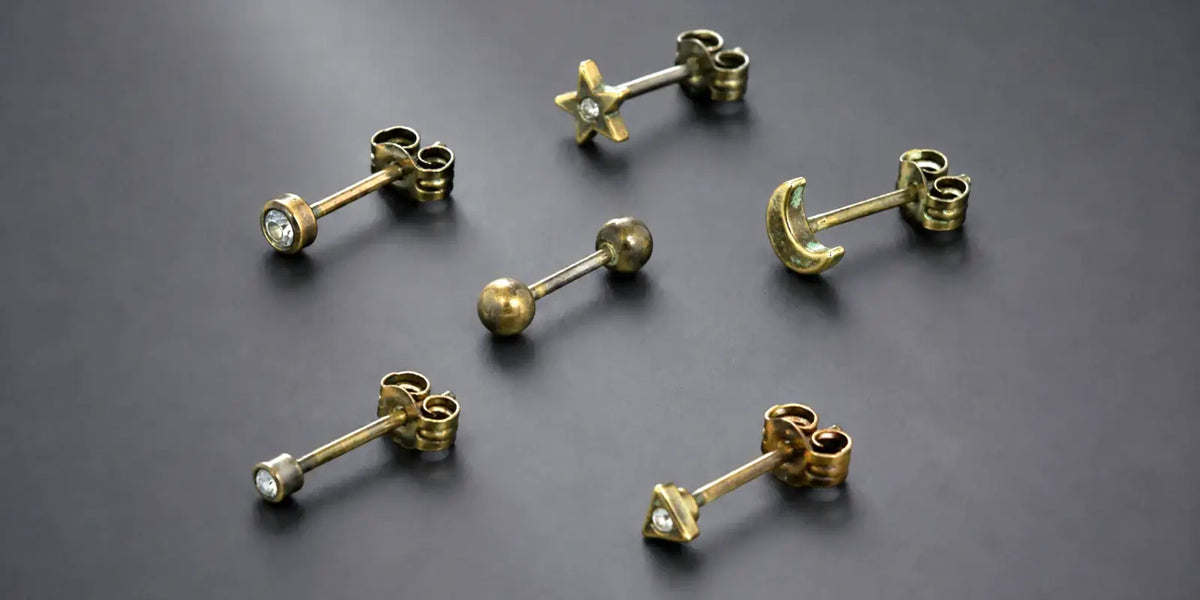
Most inexpensive piercing jewelry isn't one solid metal. It's a base metal, usually brass or copper, coated with a layer of gold or silver, often less than one micron thick, a fraction of the width of a human hair. Green skin shows up once that coating has worn through enough to expose the copper underneath. It's one of the clearest visible signs that a piece of jewelry is plated rather than solid.
WHAT'S ACTUALLY UNDER THE PLATING

Plating sits on top of the base metal instead of being part of it, so it wears down mechanically through friction, soap, sweat, and daily cleaning. That wear happens faster on a piercing than on a ring or a necklace, because the jewelry lives inside the wound and gets handled every day. Once the coating thins or cracks, the base metal is exposed directly to the piercing channel, not just to the surface of the skin.
NICKEL IRRITATION AND WHERE IT CROSSES INTO INFECTION
Many of the base metals under plating contain nickel, either in the alloy itself or in an undercoat layer applied before plating. Nickel is the most common metal allergen, and contact with it can trigger allergic contact dermatitis: redness, itching, and swelling around the piercing, as outlined by Mayo Clinic.
On a fresh piercing, the skin barrier is already open, so nickel reaches the tissue more directly than it would through intact skin. An allergic reaction and a bacterial infection can look similar at first. Redness, swelling, and discomfort show up either way. What usually separates them is progression: an allergic reaction tends to stay limited to where the metal touches skin, while an infection tends to worsen, spread, or come with discharge. Symptoms that don't improve within a few days are worth having checked by a piercer or a doctor rather than guessed at.
DO YOU NEED TO CHANGE YOUR JEWELRY?
Whether you should change your jewelry comes down to one thing: is the piercing fully healed?
If the piercing isn't fully healed yet, don't remove the jewelry yourself, no matter how new or how far along it is. An unhealed channel can start shrinking or closing within hours of the jewelry coming out. If you're noticing redness, itching, or a green tint, flag it to your piercer instead of handling it on your own. They'll assess whether it needs to come out, and if so, put in something that won't cause the same problem again.
If the piercing is fully healed, the risk changes completely. A healed channel is stable, so swapping jewelry yourself carries none of the urgency or risk that comes with an unhealed one. If plating is causing irritation or discoloration, there's no reason to wait, change it as soon as you notice the problem.
If you're starting a new piercing, the simplest move is to skip this decision altogether. Choosing solid, nickel-free metal from day one means there's no plating to wear through and no base metal underneath to react, so the entire scenario above never comes up.
WHAT SOLID, NICKEL-FREE GOLD ACTUALLY SOLVES
Solid metal removes the failure mode entirely, rather than delaying it. There's no coating to wear through, so there's no base metal hidden underneath to eventually get exposed. A piece made in solid 18k gold has the same composition all the way through. Nothing changes as it ages, because there's nothing sitting on top of something else.
Choosing nickel-free metal from the start is one of the main prevention steps recommended by the American Academy of Dermatology, and it removes the most common allergen from contact with the piercing altogether, whether the piercing is a week old or ten years healed. Between the two, most of what causes green skin, plating-related irritation, and nickel contact dermatitis stops being possible in the first place.
HOW TO TELL IF JEWELRY IS SOLID OR PLATED

This matters beyond MADAJ pieces, for anything already in your jewelry box.
Check for a hallmark stamp.
Solid gold is stamped with its purity, usually as a number: 750 for 18k, 585 for 14k, 417 for 10k. Plated pieces are either unstamped or carry a different marking altogether, such as GP (gold plated), GF (gold filled), or HGE (heavy gold electroplate). None of those three are solid gold, regardless of how the listing describes them.
Be careful with the term "gold vermeil."
It sounds premium, and by definition it's a thicker plating than standard gold plating, sterling silver coated in a real layer of gold. But it's still plating on top of a different base metal, not solid gold, and it will wear down the same way over time.
“Gold Filled” Is a Step Up, Not a Substitute.
A thicker layer of gold is mechanically bonded to a base metal core. It lasts longer than standard plating, but it's still two metals, not one, and the base metal is still there underneath. If a listing doesn't state a karat and a stamp, or uses “gold tone,” “gold finish,” or “gold plated” language, assume it's not solid.
Comparison table: solid gold, gold filled, gold vermeil, gold plated
Solid
|
Gold
|
Gold
|
Gold
|
|
| Composition | Solid gold | Jeweler's brass core | Solid 925 sterling silver base | Copper, brass, or other base alloy |
| Gold Layer | Solid, no layer | At least 5% of total weight in gold | At least 2.5 microns, 10k gold minimum | Under 1 micron, often less than a hair's width |
| Nickel Risk | None, nickel-free | Possible in the base metal once the layer wears through | Possible in the base metal beneath the silver | Common, most base metals contain nickel |
| Wears Through? | No | Slowly, over years | Faster than gold filled, thinner layer | Fast, often within months of daily wear |
| Hallmark Stamp | 750 (18k), 585 (14k) | GF | "Vermeil," not karat-stamped alone | GP, HGE, or unstamped |
| Piercing Safety | Safe for new and healed piercings | Not recommended, base metal risk over time | Not recommended, silver and base metal risk | Not recommended, highest nickel and wear risk |
| Best Suited For | New piercings and everyday long-term wear | Occasional fashion jewelry, not fresh piercings | Occasional fashion jewelry, not fresh piercings | Trend pieces meant for short-term wear |


HYPOALLERGENIC AND NICKEL-FREE ARE NOT THE SAME CLAIM
The two terms get used together often enough that they start to sound interchangeable. They aren't.
"Nickel-free" is a material fact. It means nickel isn't present in the alloy, and it can be checked against the metal's actual composition.
"Hypoallergenic" is a marketing term with no legal or regulated definition in most countries, including the United States. A brand can label something hypoallergenic without it being nickel-free, without disclosing what it's actually free of, and without any third party verifying the claim. It's a suggestion, not a specification.
MADAJ pieces are both: solid 18k gold that is nickel-free by composition, which is also why they can be accurately described as hypoallergenic rather than only marketed as such.
MADAJ PIECES BY PLACEMENT

MADAJ pieces are made in solid 18k gold (yellow, white, or rose), nickel-free and hypoallergenic throughout, set with diamond, ruby, sapphire, emerald, or black diamond.
Lobe. The most forgiving placement to heal, but still worth getting right the first time.
Helix, forward helix, rook, conch, contraconch, and antitragus. Cartilage placements, generally slower to heal and less forgiving of anything that irritates the site.
Tragus and daith. Cartilage close to the ear canal, where prolonged irritation is more noticeable day to day.
This is the placement where cheap plating fails fastest: nose and septum. Frequently touched and cleaned, which wears plating down faster than on ear placements.
Navel. Healing time is longer than most ear placements, which gives lower-quality jewelry more time to fail before healing is complete.
All MADAJ pieces are made to order; a small selection is available ready-made.
CARING FOR SOLID GOLD JEWELRY: How to Clean and Care for Solid Gold Jewelry?
Solid gold doesn't need special treatment, but a few habits keep it looking new. Clean it with mild soap and warm water, using a soft cloth or a soft-bristled brush for any detail work, then dry it fully before storing. Avoid chlorine and harsh household chemicals, which can dull the surface over time even though they won't cause the flaking or discoloration that plating does. Store pieces separately so they don't scratch against harder gemstones or other jewelry.
WHY SOLID GOLD COSTS MORE

The price difference comes down to what's in the piece and what it takes to make it.
- Material. Gold is priced as a commodity, traded daily against a global market price per gram. Solid gold contains far more actual gold than a thin plated coating, so the material cost starts from a different baseline entirely. Karat matters too: 18k gold is 75% pure gold by weight, more than a lower karat piece of the same size.
- Labor. Solid gold pieces are cast, set, and finished as a single piece, rather than molded in a cheaper base metal and coated afterward. Setting a gemstone securely into solid gold also takes more skilled work than pressing one onto a plated piece.
- Taxes. Many countries apply VAT or sales tax to jewelry, and some add specific duties on precious metals, so the same piece can cost differently from one country to the next.
What you're paying for is the metal, the making, and local tax, not a markup on the label.


Leave a comment
This site is protected by hCaptcha and the hCaptcha Privacy Policy and Terms of Service apply.