


The Classy Curated Ear: Professional Piercing Ideas
Professional style has changed. A polished appearance no longer requires removing every sign of personality, and a well-planned ear can feel as considered as a watch, a ring, or a tailored jacket.
The difference is intention.
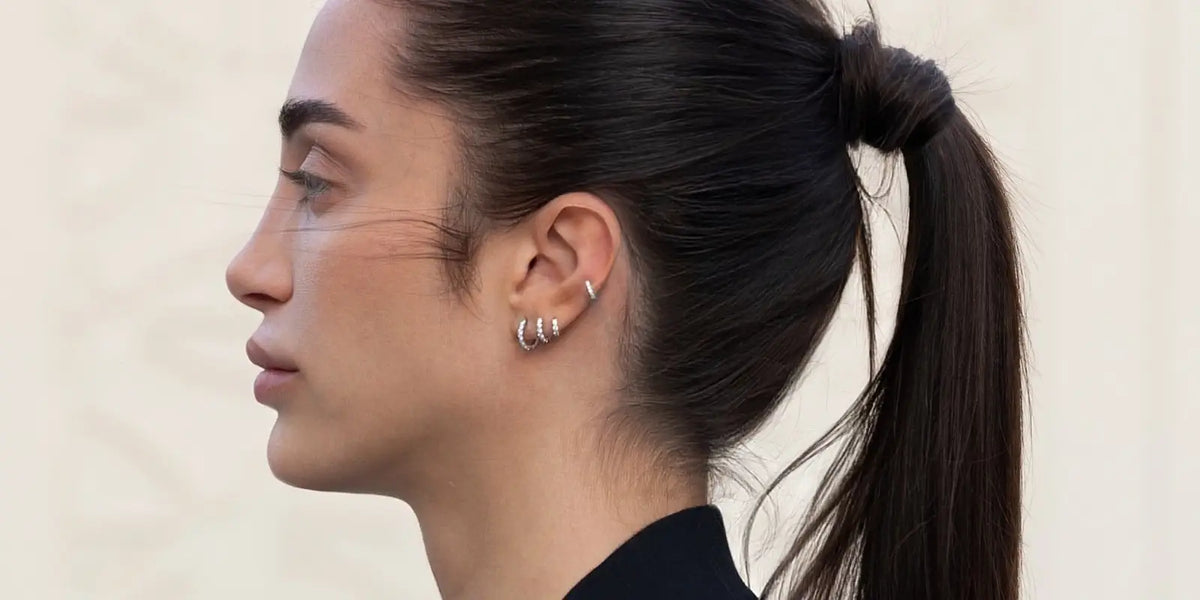
A professional ear stack should complement you, not compete with you, and it should never become the reason attention shifts away from what you're saying in a presentation or across a meeting table. It should add detail at a closer distance: a precise point of light, a clean line of gold, or a small composition that looks complete without feeling crowded.
That is what makes professional ear piercings work. The placement is thoughtful. The jewelry sits correctly. The scale is controlled. Nothing looks accidental.
Table of Contents:
-
Start With Your Actual Workplace
-
Why the Lobe Is the Professional Foundation
-
Choose Placements That Stay Close to the Ear
-
Let Studs Do Most of the Work
-
Hoops Can Still Look Polished
-
Build a Minimalist Ear Stack With Repetition
-
Keep Color Deliberate
-
Fit Is Part of the Look
-
Four Professional Ear Stack Formulas
-
What to Avoid When the Setting Is Formal
- Professional Does Not Mean Impersonal
Start With Your Actual Workplace
There is no single definition of office-appropriate style. A law firm, design studio, hospital, luxury showroom, and technology company may see the same piercing differently. Before choosing jewelry, understand the environment you are dressing for.
Look at what people in senior or client-facing roles already wear. Check any written dress code, safety requirement, or restriction around visible jewelry. Then decide how much visual presence feels right for your role.
The goal is not to make your ear invisible. It is to make it compatible with the room.
For a conservative setting, a single lobe stud or a restrained double-lobe arrangement is usually the clearest starting point. In a more flexible workplace, a small helix, tragus, or upper-lobe detail can add personality without changing the overall impression.
MADAJ's Men's Ear Piercing guide makes a useful point that applies beyond menswear: a well-proportioned lobe stud can move easily between a work meeting, an evening out, and an ordinary weekend. Versatility often begins with one piece chosen well.
Why the Lobe Is the Professional Foundation

The lobe is the most adaptable place to begin a curated ear for work. It has enough visual space for a stud or hoop, works naturally with formal clothing, and can support additional piercings later without making the ear feel immediately complex.
A single lobe piercing reads as classic. A double lobe feels more styled but can remain understated when the pieces are small and related. A third lobe adds rhythm, especially when the jewelry becomes progressively lighter as it moves upward.
For a clean three-piece arrangement, try a small stud in the first lobe, a finer stud in the second, and a tiny point of light in the third. Another option is one close-fitting hoop followed by one or two studs.
The Lobe Piercing Full Guide explains how multiple lobe piercings can be arranged according to the available space. Your anatomy should guide the spacing. The idea is to create progression, not simply fill every possible position.
Choose Placements That Stay Close to the Ear
When you are considering classy ear piercings, style matters as much as sparkle. In a professional setting, jewelry that sits close to the ear feels more polished. It moves less and draws less attention than a dangling piece that catches light and swings when you move.
Three placements work particularly well for a professional composition.
The Upper Lobe

An upper-lobe piercing develops the stack without moving fully into cartilage. A tiny stud or fine hoop usually remains connected to the look of traditional earrings.
The Helix

A helix looks clean when the jewelry follows the outer curve. A compact stud creates a quiet point at the top; a close-fitting hoop feels slightly more expressive.
The Helix Piercing Guide is useful before committing because placement and anatomy affect how the jewelry will sit.
The Tragus

The tragus sits close to the face, which makes a small stud feel deliberate without dominating the full ear. It can also balance a lobe-heavy stack by placing one detail higher and further inward.
Because this is a compact area, proportion matters. Read the Tragus Piercing Guide and speak with an experienced piercer about whether your anatomy can accommodate the placement comfortably.
A professional composition does not need all three. One additional placement is often enough.
Let Studs Do Most of the Work

For many workplaces, studs are the easiest foundation for workplace-friendly piercings. Their lower profile keeps them visually quiet, and their fixed position creates a more precise effect than jewelry with significant movement.
That does not mean the design has to be plain.
A round diamond is direct and timeless. A marquise adds length without much width. A small floral or geometric motif introduces personality, while a black diamond or colored gemstone creates controlled contrast.
Explore MADAJ’s Stud Diamond Piercing collection as a reference for how different settings, stone shapes, and proportions can change the effect of a small piece.
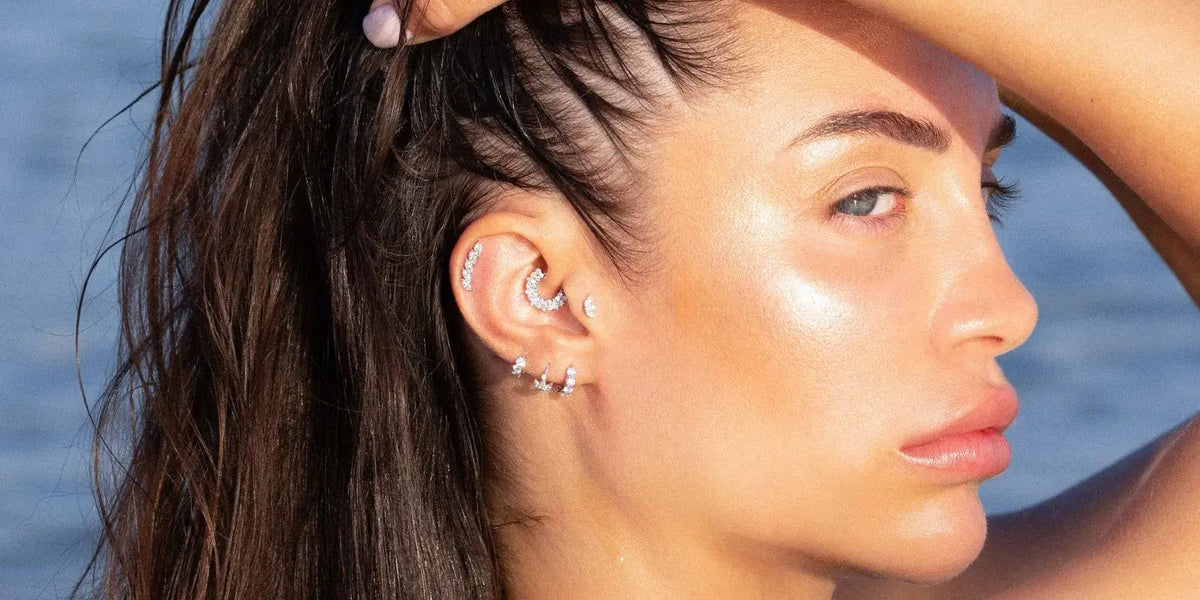
The strongest professional stacks usually choose one design language. That might be round stones, angular forms, a shared gold color, or a consistent setting style. The pieces do not have to match exactly. They only need a visible relationship.
Hoops Can Still Look Polished

Hoops are not automatically too casual or expressive for work. The question is how they fit.
A thin hoop that sits close to the lobe or helix can look sharp. A larger hoop with movement or charms has more presence and may suit a less formal setting.
For office-appropriate earrings, focus on diameter, thickness, and spacing. The hoop should not collide with nearby jewelry or create an oversized gap between the ring and the ear unless that openness is intentional.
The Ear Piercings Size Guide notes that hoop diameter and post length vary by placement and anatomy. A snug fit can create a more refined finish once the piercing is fully healed, but your piercer should confirm the correct measurement before you order or change jewelry.
Use the Hoop Diamond Piercing collection to compare restrained, close-fitting options with more decorative designs. For work, let one hoop provide the movement and keep the surrounding pieces still.
Build a Minimalist Ear Stack With Repetition

A minimalist ear stack is not defined only by the number of piercings. It is defined by how clearly the pieces relate to each other.
Repeat one element across the ear: the same gold color, the same gemstone, a consistent shape, a gradual change in size, or one shared setting style.
A diamond hoop in yellow gold, round diamond second-lobe stud, and tiny helix stud can feel connected through metal and stone even when the designs differ.
You can also use scale as the structure. Begin with the largest piece in the first lobe, then reduce the size as the stack travels upward. This follows the shape of the ear and keeps the composition from feeling top-heavy.
One repeated detail is usually enough. The ear does not need matching sets to look complete.
Keep Color Deliberate
Color can belong in an elegant professional stack, especially when it appears once.
A sapphire in white gold can feel cool and precise. An emerald in yellow gold adds richer contrast. A ruby brings warmth, while black diamond creates definition without bright sparkle.
If the gemstone is the statement, allow the rest of the professional ear stack to stay neutral. If you mix several colors, repeat them with a clear pattern rather than introducing one unrelated stone in every piercing.
The same rule applies to mixed metals. One dominant gold color with a secondary accent usually looks more intentional than an equal mix with no structure. The jewelry you already wear, a watch, rings, glasses, or necklace, can help decide which tone should lead.
Fit Is Part of the Look
An elegant design loses its effect when it tilts, snags, presses into the skin, or sits too far from the ear.
Post length affects whether a stud sits flush, while hoop diameter determines whether a ring follows the ear. Correct sizing depends on placement, anatomy, and healing stage.
MADAJ’s size guide explains that a post that is too long can rotate, catch on hair or clothing, and sit unevenly, while a post that is too short can create pressure. That is not only a comfort issue. It changes the visual result.
Threaded flat-back jewelry can be useful in a considered stack because the backing remains low-profile and the front stays securely positioned. MADAJ’s 18k Gold Guide details the brand’s use of solid, nickel-free 18k gold. For a new or healing piercing, follow the advice of your professional piercer rather than choosing jewelry on appearance alone.
Four Professional Ear Stack Formulas
These combinations offer a starting point. Adjust them to your anatomy and workplace.
1. The One-Piece Standard

Choose between a solitaire, decorative, or gemstone stud for the first lobe. This is the most restrained version of elegant ear piercings, but the quality and proportion keep it from feeling generic.
2. The Graduated Double Lobe

Choose two coordinating studs in graduated sizes, with the upper stud more subtle than the one below. Keep the gold and stone family consistent.
3. The Stud-and-Helix Balance

Place a refined stud in the first lobe and a tiny stud or close-fitting hoop in the helix. The distance between the two frames the ear without crowding it.
4. The Three-Point Composition

Combine a first-lobe stud, second-lobe stud, and a tiny tragus or helix detail. Reduce the scale as the eye moves upward and inward.
What to Avoid When the Setting Is Formal
Professional styling is often less about strict rules and more about removing distractions.
Be careful with several large hoops competing at once, charms that move noticeably during conversation, multiple unrelated gemstone colors, pieces that overlap, jewelry that requires frequent adjustment, and an unplanned mix of metals, scales, and motifs.
None of these choices is wrong. They simply create more visual activity. In a formal environment, one expressive detail usually has greater impact than several. If one piece interrupts the composition, remove it or replace it with something quieter.
Professional Does Not Mean Impersonal
The best professional ear piercings do not erase individuality. They refine it.
A diamond stud can be traditional or sharply modern. A small hoop can feel classic or architectural. A colored gemstone can hold personal meaning without becoming obvious across the room.
The aim is not approval from every possible workplace. It is alignment: with your environment, your anatomy, your clothing, and the way you want to be seen.
Start with one anchor. Keep the scale controlled. Repeat one detail. Leave enough space for every piece to be understood. Then stop before the ear begins to feel busy.
That is the classy curated ear. It works with professional clothing because it follows the same principles: fit, proportion, material, and restraint.
For help selecting the right placement, size, gold color, or gemstone combination, contact MADAJ. The team can help you build a made-to-order composition that feels polished at work and entirely your own everywhere else.

Leave a comment
This site is protected by hCaptcha and the hCaptcha Privacy Policy and Terms of Service apply.